








































































































































Disclaimer — For Research Use Only. This article is a scientific overview of MOTS-c as a research compound, intended for qualified professionals studying mitochondrial-derived peptides, metabolic signaling, and cellular biology in vitro and in preclinical models. It is not medical or veterinary guidance. MOTS-c offered as a research compound is not a pharmaceutical product, is not for human or animal consumption, and nothing here should be read as a description of human use, dosing, or therapeutic effect.
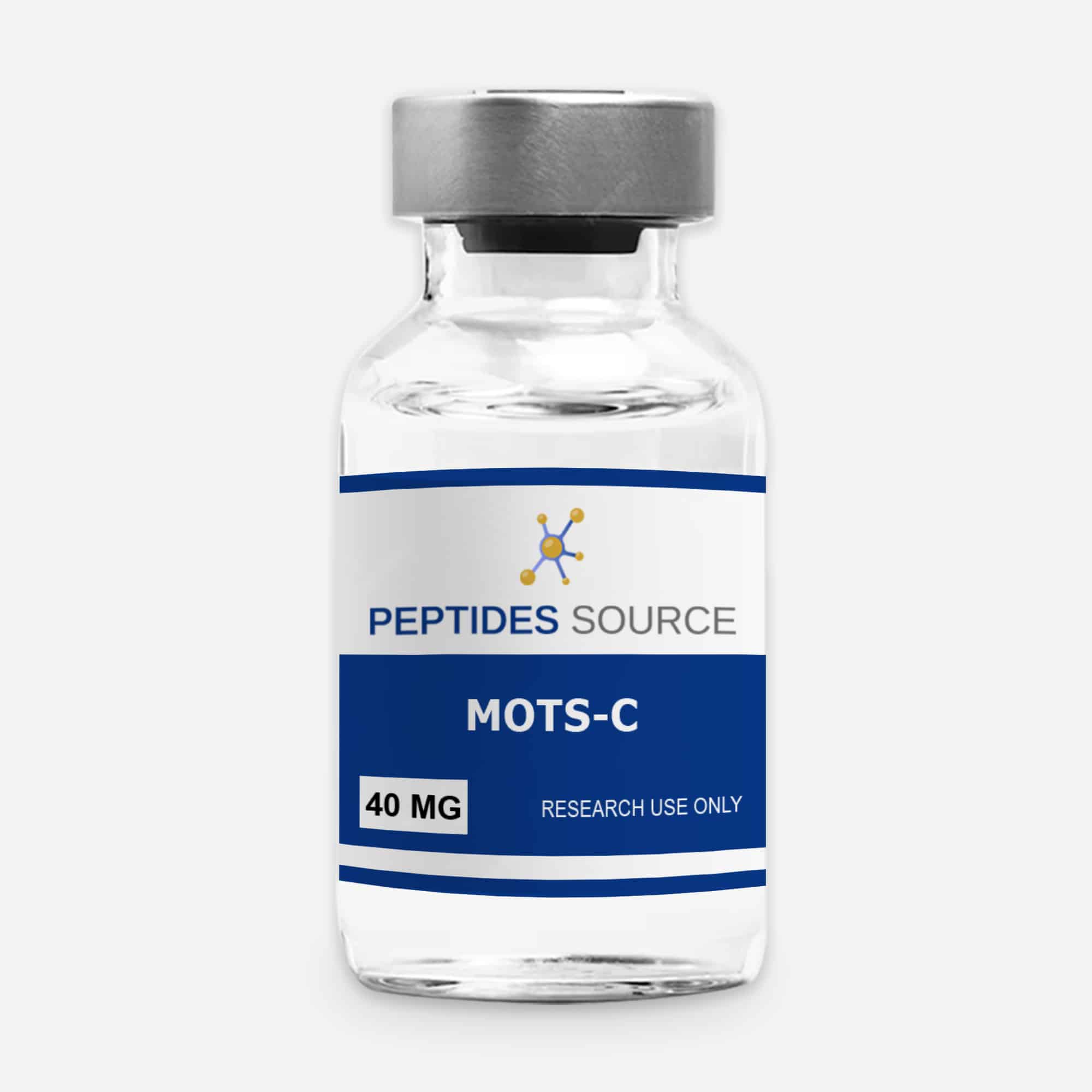
MOTS-c (Mitochondrial Open Reading Frame of the 12S rRNA type-c) is a 16-amino-acid peptide encoded not in nuclear DNA but within the mitochondrial genome — specifically inside the 12S ribosomal RNA gene, a locus once assumed to carry no protein-coding information. It is not a synthetic fragment of a known hormone; it is a naturally encoded peptide the cell itself generates, now available as a lyophilized research tool.
First characterized in 2015 by Lee et al. in Cell Metabolism, it belongs to the emerging class of mitochondrial-derived peptides (MDPs) studied in preclinical models as metabolic signaling molecules that link organelle energy status to whole-cell responses. Under metabolic stress, MOTS-c exits the mitochondria and translocates to the nucleus — a behavior the literature terms mitochondria-to-nuclear retrograde signaling — where it modulates gene expression directly.
What makes it especially tractable as a research tool is that endogenous MOTS-c levels vary with age and metabolic state in animal models, making it a compound of interest not just for studying metabolism in isolation but for understanding how the mitochondria communicates outward to regulate it. Browse the Cellular Longevity Research category for the broader compound landscape.
What MOTS-c Is Studied For
The preclinical literature covers several distinct research areas:
- Metabolic regulation and insulin sensitivity. The central finding from the Lee 2015 Cell Metabolism paper: MOTS-c influences glucose handling and metabolic homeostasis in rodent models through AMPK activation.
- Exercise mimetics research. MOTS-c has been described as a mitochondrial “exercise mimetic” in animal studies — activating some of the same metabolic signaling pathways associated with physical exercise, making it a tool for studying those pathways independently.
- Cellular senescence and aging biology. Kim et al. (2018) characterized MOTS-c’s role in mitochondrial function during cellular senescence in murine models.
- Age-related physical decline. Reynolds et al. (2021) demonstrated that endogenous MOTS-c levels decline with age in mice, and that exogenous administration in aged animals was associated with improvements in grip strength and exercise capacity measures.
- Cancer biology. More recent work has examined MOTS-c in tumor-suppression contexts, including studies of its effects on ovarian cancer cell lines in vitro.
All of this research is preclinical. There are no published controlled human clinical trials evaluating exogenous MOTS-c administration.
How MOTS-c Works
The mechanism centers on the mitochondrial folate cycle. In preclinical models, MOTS-c interferes with MTHFD2 — an enzyme central to one-carbon metabolism in the mitochondria.
This disruption causes accumulation of AICAR (5-aminoimidazole-4-carboxamide ribonucleotide), a purine-synthesis intermediate that directly activates AMPK by mimicking AMP. AMPK is a master cellular energy sensor that shifts cells toward fat oxidation and improved glucose handling when activated.
This is why MOTS-c is mechanistically connected to AICAR, which is itself a well-established standalone AMPK activator in preclinical research. MOTS-c produces AICAR as a downstream consequence; AICAR can be used to activate AMPK directly without the upstream MDP mechanism. The two compounds are complementary tools for studying the same pathway from different points of entry.
A second layer involves subcellular movement. Kim et al. (2018) showed that under metabolic stress, MOTS-c exits the mitochondria and translocates to the nucleus, where it modulates nuclear gene expression — a process the research literature describes as mitochondria-to-nuclear retrograde signaling. This makes MOTS-c mechanistically distinct from AMPK activators that operate entirely outside the organelle.
What the Preclinical Evidence Shows
Three landmark studies define the current evidence base for MOTS-c in the preclinical literature:
Lee et al. (2015) — Cell Metabolism. The foundational paper. Demonstrated MOTS-c’s metabolic effects in mouse models and identified the folate-cycle/AICAR/AMPK mechanism. Established MOTS-c as detectable in plasma with levels that vary by metabolic state.
Kim SJ et al. (2018) — Aging (Albany NY). Characterized MOTS-c’s role in mitochondrial function during cellular senescence in murine models, and documented the nuclear translocation behavior under metabolic stress conditions. PMID 29886458.
Reynolds et al. (2021) — Nature Communications. Showed that MOTS-c is an exercise-induced, mitochondria-encoded regulator of age-related physical decline and muscle homeostasis in aged mice. Exogenous MOTS-c administration in aged animals was associated with improvements in grip strength and treadmill performance metrics compared to controls.
One critical distinction applies to all of this evidence: observational data showing that endogenous MOTS-c levels correlate with age or metabolic state in biological samples is not the same as interventional evidence from exogenous administration. The Reynolds 2021 paper provides the strongest interventional data — and it is entirely in animal models.
MOTS-c vs. Related Research Compounds
Researchers working in metabolic, longevity, or senescence biology will encounter several compounds that touch overlapping mechanisms. Understanding where MOTS-c sits relative to them helps in experimental design:
MOTS-c vs. AICAR: MOTS-c acts upstream of AICAR in the folate-cycle pathway; AICAR provides direct AMPK activation without the mitochondrial folate mechanism. Experiments asking about the MDP-to-AMPK pathway use MOTS-c; experiments asking about AMPK activation itself use AICAR. Both are available from Peptides Source.
MOTS-c vs. Epithalon: Epithalon (Epitalon) is a synthetic tetrapeptide studied for telomerase activation and neuroendocrine regulation — a different mechanistic target and genomic biology. It is grouped with MOTS-c in longevity research programs but addresses distinct pathways.
MOTS-c vs. Humanin: Humanin is another MDP, encoded elsewhere in the mitochondrial genome, studied for cytoprotective and neuroprotective effects. The two MDPs are sometimes studied together to map the broader MDP signaling landscape, but their mechanisms and research applications are distinct.
Researchers building multi-pathway longevity or metabolic research programs will also find the following compound profiles useful as adjacent references: the Dihexa research profile (HGF/c-Met synaptogenic signaling in neuropeptide research), the KPV peptide profile (PepT1-mediated NF-κB anti-inflammatory pathway), and the neuropeptide research overview. Full research catalog: Peptides Source.
Handling and Quality Notes
MOTS-c is supplied as a lyophilized white powder. At 2,174.5 Da with a predominantly hydrophilic sequence (MRWQEMGYIFYPRKLR), it is generally soluble in sterile water or aqueous buffer — confirm solubility in your specific diluent before use.
Long-term storage at −20 °C in a desiccated, light-protected environment is standard. Our laboratory guide to reconstituting research peptides covers diluent selection, concentration calculation, and aliquoting strategy.
Peptides Source supplies MOTS-c at ≥98% HPLC-confirmed purity with a third-party certificate of analysis on every lot, manufactured to cGMP/ISO standards in the USA.
| Property | Value |
|---|---|
| Compound class | Mitochondrial-derived peptide (MDP) |
| Genomic origin | ORF within human mitochondrial 12S rRNA gene |
| Amino acid sequence | MRWQEMGYIFYPRKLR (16 aa) |
| Molecular formula | C95H155N31O26S |
| Molecular weight | ~2,174.5 Da |
| PubChem CID | 137500027 |
Frequently Asked Questions
What is MOTS-c?
MOTS-c is a 16-amino-acid peptide encoded by an open reading frame within the human mitochondrial 12S rRNA gene — making it a mitochondrial-derived peptide (MDP) rather than a nuclear-encoded or synthetic compound. It was first characterized by Lee et al. in 2015 and is studied in preclinical models for its roles in metabolic regulation, AMPK signaling, and cellular stress responses. It is supplied by Peptides Source strictly for in vitro and laboratory research use.
What is MOTS-c studied for in preclinical research?
The primary research applications are metabolic regulation and insulin sensitivity (via AMPK activation), exercise-mimetic biology, cellular senescence, age-related physical decline in animal models, and more recently, cancer cell biology in vitro. All published interventional data is from in vitro assays or animal models; no controlled human clinical trials have been published.
How does MOTS-c activate AMPK?
MOTS-c activates AMPK indirectly through the mitochondrial folate cycle. It interferes with MTHFD2, causing accumulation of AICAR — a purine intermediate that mimics AMP and directly activates AMPK. Under metabolic stress in animal models, MOTS-c also translocates to the nucleus to modulate gene expression. This upstream MDP mechanism is distinct from direct AMPK activators like AICAR, which can be used to study AMPK activation independently.
How does MOTS-c differ from AICAR as a research tool?
MOTS-c acts upstream of AICAR in the pathway: it disrupts the mitochondrial folate cycle, which leads to AICAR accumulation, which then activates AMPK. Using MOTS-c studies the complete upstream-to-AMPK pathway; using AICAR studies AMPK activation directly without the folate-cycle mechanism. Researchers investigating where in the pathway an effect originates would use both compounds in complementary experimental designs.
Has MOTS-c been studied in humans?
Observational studies have measured endogenous MOTS-c in human plasma as a biomarker — levels have been observed to correlate with age and metabolic state — but these are descriptive, not interventional. There are no published controlled trials evaluating exogenous MOTS-c administration in humans. All mechanism and intervention data is from in vitro assays and rodent models. Nothing in this article describes or implies human use, dosing, or therapeutic effect.
Disclaimer — For Research Use Only. The information above is provided solely for in-vitro and preclinical research context. MOTS-c offered as a research compound is not a pharmaceutical product, is not intended for human or animal consumption, and none of the molecular, mechanistic, or preclinical information here describes or implies human use, dosing, or therapeutic effect.
References
- PubChem, Compound Summary: MOTS-c (CID 137500027), National Center for Biotechnology Information.
- Lee C, et al. The mitochondrial-derived peptide MOTS-c promotes metabolic homeostasis and reduces obesity and insulin resistance. Cell Metab. 2015;21(3):443–454. PMID 25738459.
- Kim SJ, Mehta HH, Wan J, et al. Mitochondrial peptides modulate mitochondrial function during cellular senescence. Aging (Albany NY). 2018;10(6):1239–1256. PMID 29886458.
- Reynolds JC, et al. MOTS-c is an exercise-induced mitochondrial-encoded regulator of age-dependent physical decline and muscle homeostasis. Nat Commun. 2021;12:470. PMID 33479240.