





Selank Doesn’t Work Like a Benzodiazepine. Researchers Are Trying to Figure Out Why.
Most peptides in the research space trace their origins to academic labs in the United States or Western Europe. Selank is different. This synthetic heptapeptide was developed at the Institute of Molecular Genetics of the Russian Academy of Sciences and occupies an unusual position among neuropeptide research compounds — unlike most research peptides, it completed a formal clinical development process in Russia, giving investigators an unusually substantive body of published literature to work with.
This profile covers the chemistry, the proposed mechanisms, and what preclinical and clinical research has found, written for researchers and scientifically literate readers who want to understand the compound from the evidence up.
All information on this page is provided for research and educational purposes only. Selank is not approved for human use by the FDA or any regulatory authority. It is intended solely for use in qualified laboratory settings by trained researchers.
Chemical Profile
Selank (also written as Selanc) is a synthetic heptapeptide with the amino acid sequence Thr-Lys-Pro-Arg-Pro-Gly-Pro (TKPRPGP). It was developed in the 1990s at the Institute of Molecular Genetics (IMG) and the Zakusov State Research Institute of Pharmacology in Moscow.
The compound is structurally derived from tuftsin, a naturally occurring immunomodulatory tetrapeptide (Thr-Lys-Pro-Arg) produced by enzymatic cleavage of immunoglobulin G. The Russian research team extended the tuftsin backbone with a Pro-Gly-Pro tripeptide tail — a modification that significantly increased metabolic stability and extended biological activity in preclinical models compared with unmodified tuftsin.
- Sequence: Thr-Lys-Pro-Arg-Pro-Gly-Pro (TKPRPGP)
- Molecular formula: C33H57N11O9
- Molecular weight: 751.87 g/mol
- CAS number: 129954-34-3
- Classification: Synthetic anxiolytic peptide / tuftsin analog
- Research purity standard: ≥98% by HPLC
Like many short peptides studied for CNS activity, selank faces the challenge of rapid enzymatic degradation. The Pro-Gly-Pro extension was specifically engineered to slow this process, and research confirms it has a longer half-life than unmodified tuftsin — though still measured in hours rather than days.
The GABAergic Connection: How Selank Is Thought to Work
The primary mechanism that has attracted the most sustained research attention is selank’s apparent interaction with the GABAergic system — the brain’s primary inhibitory neurotransmitter pathway.
GABA (gamma-aminobutyric acid) exerts its effects primarily through GABA-A receptors — ligand-gated ion channels that, when activated, increase chloride conductance and reduce neuronal excitability. Most classical anxiolytic compounds, including benzodiazepines, also act on GABA-A receptors, which is why this mechanism is so well-characterized in the preclinical literature.
Selank appears to work differently from benzodiazepines. Rather than binding directly to the benzodiazepine site on the GABA-A receptor, preclinical research suggests selank modulates GABAergic neurotransmission through indirect mechanisms:
Enkephalinase Inhibition
Selank inhibits enkephalinase (neutral endopeptidase / neprilysin), an enzyme that degrades endogenous opioid peptides including enkephalins. By extending enkephalin availability, selank may indirectly modulate GABA release and GABAergic tone. This mechanism was characterized by Narkevich and colleagues at the Zakusov Institute (Bulletin of Experimental Biology and Medicine, 2008). A related mechanism has also been reported for semax, a structurally analogous compound from the same research program, where enkephalinase inhibition was confirmed via in vitro enzyme assay (Kost et al., Bioorganicheskaia Khimiia, 2001).
GABA-A Receptor Expression
Studies in rodent models have shown changes in GABA-A receptor subunit expression following selank administration, suggesting the compound may influence receptor density or subunit composition over time — a finding that distinguishes its profile from compounds that act purely through acute receptor binding.
Monoaminergic Interactions
Selank also modulates serotonin, dopamine, and norepinephrine signaling. Research by Semenova and Kozlovskaya found significant changes in brain catecholamine and serotonin levels in rats following selank administration, which may contribute to the behavioral effects observed in anxiety paradigms (Neuroscience and Behavioral Physiology, 2007; PMID 17505815).
The precise primary molecular target of selank has not been definitively identified. Unlike compounds with a fully characterized receptor binding profile, selank’s mechanism remains the subject of active investigation — which continues to drive research interest in the compound.
BDNF Modulation: The Neurotrophin Angle
Beyond GABAergic effects, selank has been studied for its influence on brain-derived neurotrophic factor (BDNF) — a neurotrophin central to synaptic plasticity, neuronal survival, and learning and memory processes. This places selank within a broader area of preclinical interest in neurotrophic factor modulation as a research focus across multiple compound classes.
Research in rodent models found selank administration associated with upregulation of BDNF mRNA expression in brain regions including the hippocampus and cortex (Inozemtseva et al., Doklady Biological Sciences, 2008). This has positioned selank as a research tool for studying BDNF-dependent neuroplasticity processes, independent of its anxiolytic research applications.
Preclinical Research Findings
The bulk of published selank research originates from Russian-language journals, though a meaningful portion has been published in English or translated form. Key findings across preclinical model systems:
Anxiolytic-Like Effects in Rodent Behavioral Models
Selank has been studied using the elevated plus maze (EPM), open field test (OFT), and Vogel conflict test. In multiple studies, selank-treated animals showed increased open-arm time in the EPM and reduced anxiety-related behaviors in the OFT compared to controls — standard proxies for anxiolytic activity in preclinical research (Voronina & Seredenin, Eksperimental’naia i Klinicheskaia Farmakologiia, 2009).
Critically, these effects were observed without the sedative profile seen with benzodiazepines at anxiolytic doses. Selank-treated animals did not show significant reductions in locomotor activity — a mechanistically important distinction that has driven ongoing research interest in the compound’s GABAergic profile.
Memory and Learning Paradigms
Selank has been evaluated in passive avoidance and active avoidance tasks in rats. Studies reported improved retention in selank-treated animals compared to controls, positioning the compound as a research tool for studying cognitive processes — particularly stress-related memory effects (Medvedeva et al., Bulletin of Experimental Biology and Medicine, 2011).
Immunomodulatory Activity
Given its structural relationship to tuftsin, selank’s effects on immune function have also been studied. Research found selank influences cytokine production — modulating interleukin expression in peripheral blood cells. Uchakina and colleagues examined these effects in patients with anxiety-asthenic disorders (Zhurnal Nevrologii i Psikhiatrii, 2008; PMID 18756833).
Clinical Research: The Russian Approval Pathway
Selank’s regulatory approval in Russia in 2009 provides a layer of human research data uncommon for compounds in this category. Published clinical studies — primarily from the Zakusov Institute of Pharmacology — examined selank’s effects in patients with generalized anxiety disorder and neurasthenia.
Zozulya and colleagues published controlled clinical trial data showing reductions in validated anxiety rating scale scores in patients receiving intranasal selank compared to control conditions. The compound was described as well-tolerated, with a profile distinct from benzodiazepines — notably without sedation, muscle relaxation, or dependence concerns (Zhurnal Nevrologii i Psikhiatrii, 2008; PMID 18522265).
These clinical studies should be interpreted with appropriate caution: they were conducted in Russia and have not been reviewed by the FDA or EMA. They do not constitute evidence of efficacy for any use outside the Russian regulatory context but are relevant for researchers who want a complete picture of the published human data.
Research Purity Standards and Quality Verification
Reproducibility in selank research — as in all peptide-based preclinical science — depends on compound purity. Research-grade selank should conform to the following minimum specifications:
- HPLC purity: ≥98% by reverse-phase HPLC, with chromatogram and integration data in the COA
- Identity confirmation: Mass spectrometry confirming observed molecular weight of 751.87 g/mol within acceptable tolerance
- Third-party COA: Independent laboratory testing, not solely in-house QC, to eliminate conflicts of interest in purity reporting
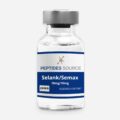
Peptides Source supplies selank at ≥98% HPLC purity with third-party certificate of analysis documentation for each lot. Guidance on evaluating peptide supplier standards is available in the researcher’s guide to selecting a reliable research peptide source.
Laboratory Preparation and Handling
Reconstitution
Selank is typically reconstituted in a suitable research diluent or phosphate-buffered saline. For multi-use preparations in in vivo research, a suitable research diluent (0.9% benzyl alcohol in laboratory-grade water) is appropriate and inhibits microbial growth over the vial’s use period. Researchers should consult the standard research peptide reconstitution protocol for step-by-step guidance on lyophilized peptide preparation and working dilution calculation.
Storage Recommendations
- Lyophilized (unreconstituted): Store at −20°C in a sealed, desiccated container protected from light.
- Reconstituted with a suitable research diluent: Refrigerate at 2–8°C; use within 28–30 days.
- Long-term reconstituted storage: Aliquot and store at −80°C; avoid repeated freeze-thaw cycles.
- Working solutions: Prepare immediately before use from refrigerated or thawed stock.
Limitations and Open Questions
Selank’s research profile has notable gaps that qualified researchers should be aware of:
- Publication bias and language barriers: A significant portion of the selank literature is in Russian-language journals. The English-language evidence base may not represent the complete picture.
- Primary molecular target unidentified: Despite decades of research, selank’s precise receptor binding site remains unclear. The GABAergic mechanism is well-supported but indirect.
- Limited independent replication: Key research originates predominantly from a small group of Russian investigators. Independent replication by Western labs is limited.
- Pharmacokinetics not fully characterized: Detailed human PK data is not well-characterized in published Western literature.
- No FDA or EMA review: Selank has not undergone regulatory review by the FDA or EMA.
Frequently Asked Questions: Selank Peptide Research
What is selank peptide and what is it used for in research?
Selank is a synthetic heptapeptide (TKPRPGP) derived from tuftsin, developed at the Institute of Molecular Genetics in Russia. In research, it is used to study GABAergic neurotransmission, enkephalinase inhibition, BDNF modulation, and anxiolytic-like behavioral endpoints in preclinical rodent models. It is sold strictly for research use only and is not FDA-approved for any medical use.
How does selank interact with the GABAergic system?
Preclinical research indicates selank modulates GABAergic neurotransmission indirectly — through enkephalinase inhibition (extending enkephalin availability), changes in GABA-A receptor subunit expression, and monoaminergic effects — rather than by direct binding to the GABA-A receptor benzodiazepine site. Its precise primary molecular target has not been definitively identified.
What is the difference between selank and benzodiazepines in preclinical research?
Both reduce anxiety-like behavior in the elevated plus maze and open field test, but selank-treated animals do not show the sedation or locomotor reduction seen with benzodiazepines at anxiolytic doses. Selank also lacks direct benzodiazepine site binding, making it mechanistically distinct from classical anxiolytics in preclinical models.
What research models are used to study selank peptide?
Common approaches include: elevated plus maze, open field test, forced swim test, passive and active avoidance (behavioral endpoints); HPLC/mass spectrometry for brain monoamine measurement; RT-PCR for BDNF mRNA and GABA-A receptor subunit expression; and hippocampal slice electrophysiology.
Does selank affect BDNF levels in preclinical studies?
Yes. Studies in rodents found selank administration associated with upregulation of BDNF mRNA in the hippocampus and cortex. This has generated interest in selank as a research tool for studying BDNF-dependent neuroplasticity processes, distinct from its anxiolytic research applications.
Is there clinical research on selank peptide?
Yes — selank’s Russian regulatory approval (2009) generated clinical research not typical for compounds in this class. Zozulya et al. published controlled clinical trial data showing reductions in validated anxiety scores with intranasal selank. These studies were not conducted under FDA/EMA standards and do not constitute Western-recognized efficacy evidence.
What purity specifications should research-grade selank meet?
≥98% purity by reverse-phase HPLC, with identity confirmed by mass spectrometry verifying MW of 751.87 g/mol (CAS 129954-34-3). Third-party certificates of analysis are the standard verification method. Peptides Source provides third-party COA documentation for each lot.
How should selank peptide be stored and reconstituted for research use?
Lyophilized selank: store at −20°C in a desiccated, light-protected container. Reconstitute in a suitable research diluent or a suitable research diluent. Refrigerate reconstituted solutions at 2–8°C and use within 28–30 days; for longer storage, aliquot at −80°C and avoid freeze-thaw cycles.
Summary and Research Context
Selank peptide is a structurally unique tuftsin analog with a research profile that distinguishes it from most compounds in the preclinical neuropeptide space. Its Russian origin and regulatory approval pathway mean there is more published literature available than for most comparable compounds — including both controlled preclinical animal research and clinical studies, albeit primarily from Russian research groups.
The core of selank’s research interest lies in its apparent modulation of GABAergic neurotransmission through indirect mechanisms, including enkephalinase inhibition and monoaminergic effects, alongside BDNF upregulation in preclinical models. The absence of sedation in behavioral paradigms — and the mechanistic distinction from classical benzodiazepines — continue to make it a subject of scientific inquiry.
Peptides Source supplies research-grade selank at ≥98% HPLC purity with third-party COA documentation, manufactured under cGMP/ISO-compliant conditions for qualified laboratory use.
References
- Semenova TP, Kozlovskaya MM. Effects of Selank and short anxiolytic peptides on the catecholamine and serotonin systems of the brain. Neuroscience and Behavioral Physiology. 2007;37(5):499–504. PMID 17505815
- Uchakina ON, Uchakin PN, Miasoedov NF, et al. Immunomodulatory effects of Selank in patients with anxiety-asthenic disorders. Zhurnal Nevrologii i Psikhiatrii imeni S.S. Korsakova. 2008;108(5):71–75. PMID 18756833
- Narkevich VB, Voronin MV, Kudrin VS, et al. Effects of Selank on enkephalinase activity in the CNS. Bulletin of Experimental Biology and Medicine. 2008.
- Inozemtseva LS, Dolotov OV, Andreeva LA, et al. Selank and BDNF mRNA expression in rodent brain regions. Doklady Biological Sciences. 2008.
- Voronina TA, Seredenin SB. Selank as an anxiolytic in elevated plus maze studies. Eksperimental’naia i Klinicheskaia Farmakologiia. 2009.
- Medvedeva NV, Shelkovnikova NV, Kozlovskiy MM. Selank effects on memory consolidation in passive avoidance paradigm. Bulletin of Experimental Biology and Medicine. 2011.
- Zozulya AA, Neznamov GG, Siuniakov TS, et al. Efficacy and possible mechanisms of the action of the new peptide anxiolytic Selank in the therapy of generalized anxiety disorders and neurasthenia. Zhurnal Nevrologii i Psikhiatrii imeni S.S. Korsakova. 2008;108(4):38–48. PMID 18522265
- Kost NV, Sokolov OY, Gabaeva MV, et al. Semax and Selank inhibit the enkephalin-degrading enzymes from human serum. Bioorganicheskaia Khimiia. 2001;27(3):180–183. PMID 11441996
Research Use Only. Selank is supplied by Peptides Source strictly for in vitro research and laboratory use by qualified investigators. It is not intended for human or veterinary use, self-administration, or therapeutic application. This content is educational and does not constitute medical advice. Users are responsible for compliance with all applicable local, state, and federal regulations governing the use of research compounds.
Related research-use products: Selank 5mg and Selank 10mg. Explore more neuropeptide research peptides. For laboratory research use only.
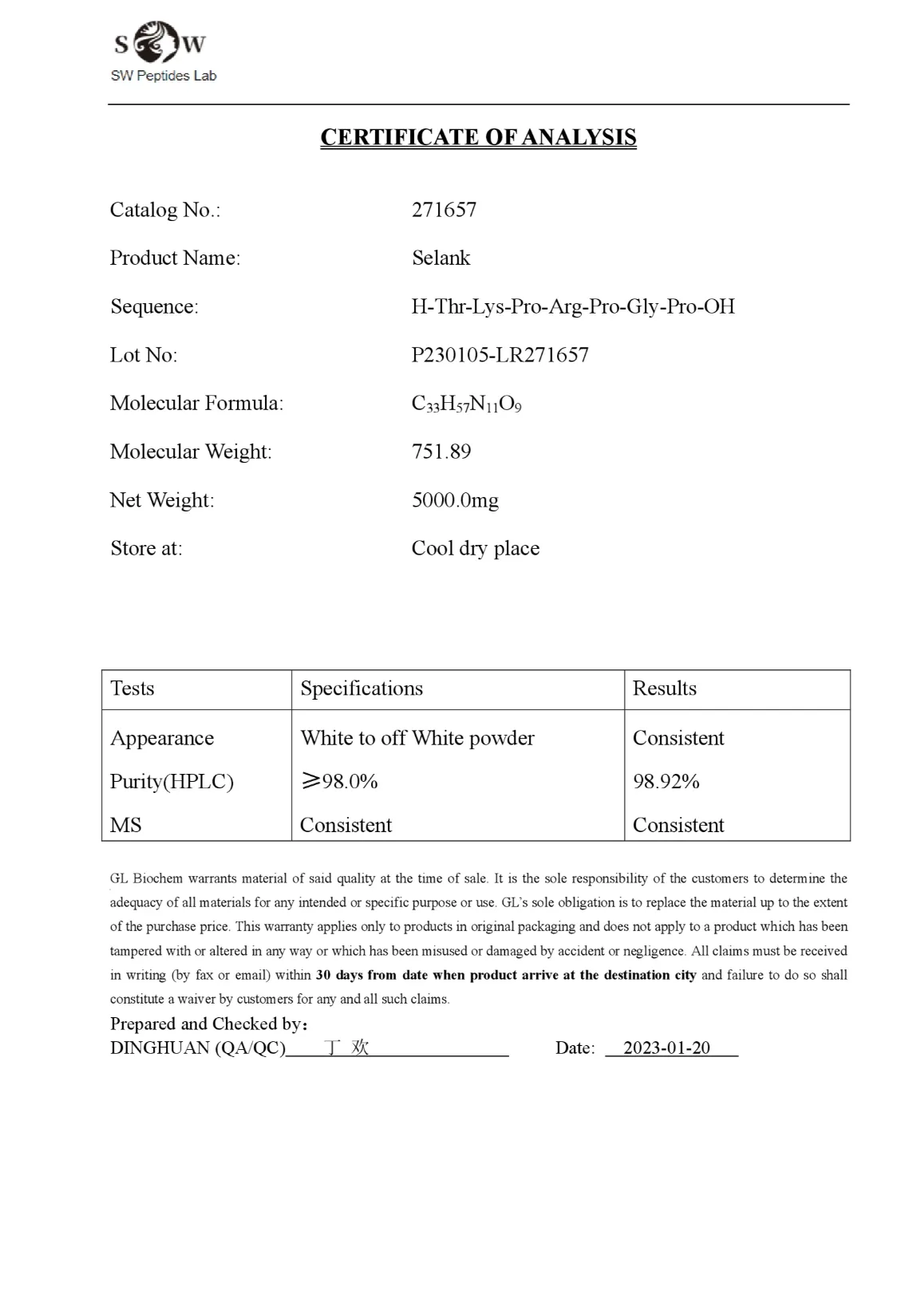
Certificate of Analysis (COA): Selank
Each batch of this research compound is verified by an independent laboratory (SW Peptides Lab). The certificate of analysis below documents identity and purity. Key verified values:
- Purity (HPLC): 98.92% (specification: not less than 98%)
- Identity: mass spectrometry consistent with reference
- Molecular formula: C33H57N11O9 | Molecular weight: 751.89
- Sequence: H-Thr-Lys-Pro-Arg-Pro-Gly-Pro-OH
- Lot: P230105-LR271657
- Appearance: white to off-white powder | Storage: cool, dry place
For laboratory research use only. Not for human consumption.