
Disclaimer — For Research Use Only. This article is a scientific overview of Dihexa as a research compound, intended for qualified professionals studying neurotrophic signaling and synaptic biology in vitro and in preclinical models. It is not medical or veterinary guidance. Dihexa offered as a research compound is not a pharmaceutical product, is not for human or animal consumption, and nothing here should be read as a description of human use, dosing, or therapeutic effect.
Most research peptides are exactly what they sound like: short chains of amino acids. Dihexa is the interesting exception. It began as a fragment of a blood-pressure hormone, was rebuilt in the laboratory into something that is only part peptide, and then turned out to work through a signaling system almost nobody expected. For researchers, that unusual pedigree is precisely what makes it worth understanding carefully — and worth handling with a critical eye. This overview walks through where Dihexa came from, what it actually is at the molecular level, how its proposed mechanism works, and how to read its preclinical literature honestly.
The Angiotensin IV Origin Story
Dihexa’s lineage starts with angiotensin IV (AngIV), a six-amino-acid fragment of the angiotensin system. Beginning in the early 1990s, researchers observed that AngIV influenced learning and memory measures in rodent models, which prompted interest in the fragment as a neuroscience research tool. The problem was practical: native AngIV is degraded very quickly, giving researchers little to work with in vivo.
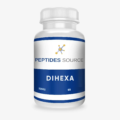
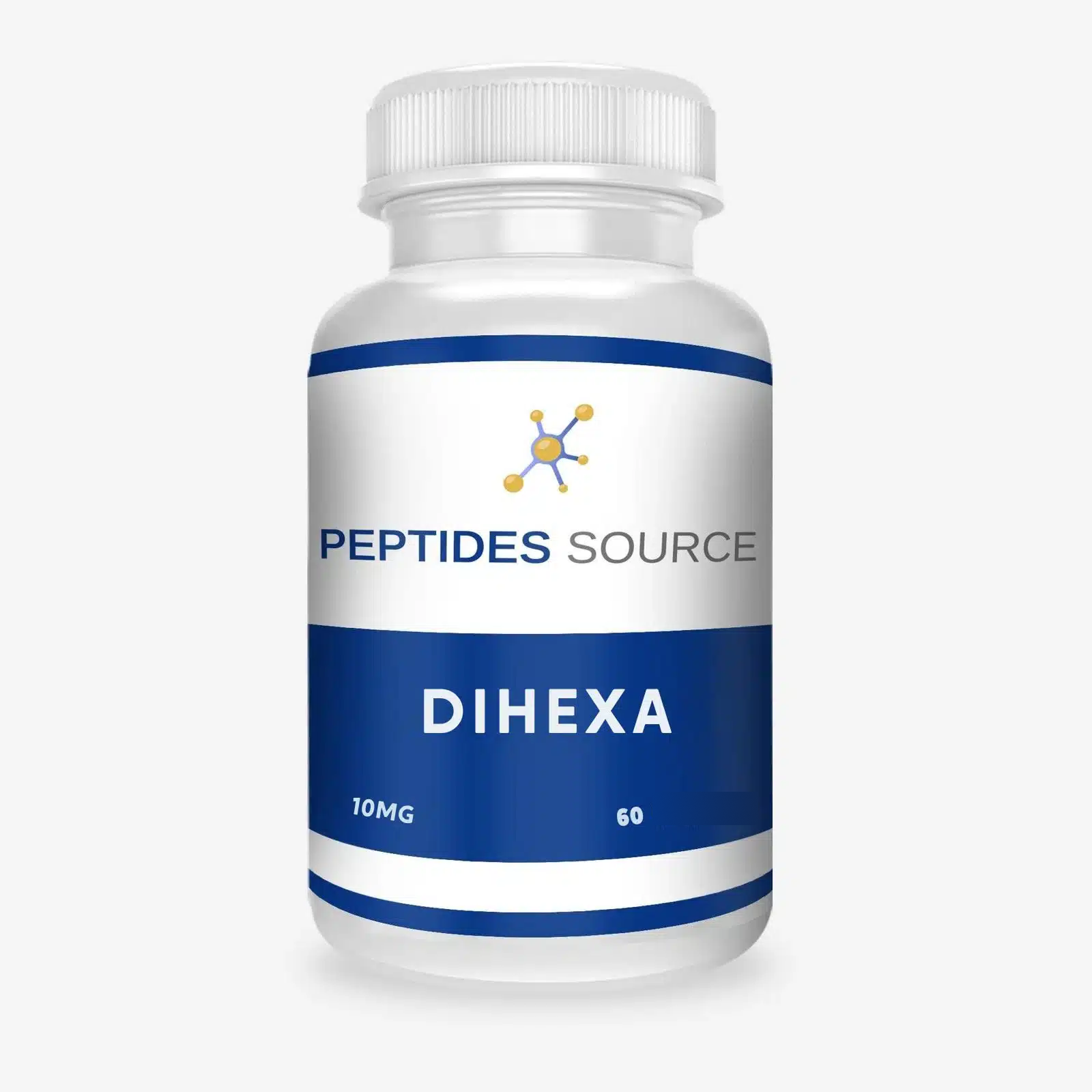
The response was medicinal chemistry. Investigators built metabolically stabilized analogs of AngIV, capping the molecule so enzymes could not take it apart as readily. Dihexa — developmental code PNB-0408 — emerged from that effort as a small, stabilized molecule engineered to be orally bioavailable and able to cross the blood-brain barrier in preclinical models. In other words, Dihexa is not a naturally occurring peptide; it is a designed research compound built to overcome the limitations of the fragment that inspired it. For laboratory use it is supplied in capsule form as Dihexa 10mg (60 capsules).
A Peptide That Isn’t Quite a Peptide
Because of that design history, Dihexa is best classified as a peptidomimetic — a small molecule that mimics a peptide but is chemically modified so it behaves more like a stable drug-like compound than a fragile amino-acid chain. Its structure, N-hexanoic-Tyr-Ile-(6)-aminohexanoic amide, carries lipid-like caps at each end that account for both its stability and its ability to move across membranes. This distinction matters in the lab: Dihexa’s handling, solubility, and stability profile differ from those of a conventional linear peptide, and researchers should treat it accordingly.
| Property | Value |
|---|---|
| Compound class | Angiotensin IV (AngIV) analog / peptidomimetic |
| Developmental code | PNB-0408 |
| Chemical name | N-hexanoic-Tyr-Ile-(6)-aminohexanoic amide |
| Molecular formula | C27H44N4O5 |
| Molecular weight | 504.7 g/mol |
| PubChem CID | 129010512 |
| CAS number | 1401708-83-5 |
Why the Mechanism Surprised Researchers
The natural assumption would be that an angiotensin IV analog acts on angiotensin receptors. The preclinical literature points somewhere else. Dihexa’s activity in these studies is attributed not to the classical angiotensin AT4 receptor but to the hepatocyte growth factor (HGF) / c-Met system — a receptor-tyrosine-kinase pathway involved in growth and neurotrophic signaling.
The proposed model is that Dihexa binds hepatocyte growth factor and potentiates its signaling at the c-Met receptor. In rodent studies, AngIV-derived compounds acting through this pathway have been associated with hippocampal spinogenesis and synaptogenesis — measurable increases in dendritic spine and synapse formation in those experimental systems. Critically, researchers have shown that these synaptogenic effects depend on an intact HGF/c-Met system, which is the main line of evidence pointing to that pathway rather than angiotensin-receptor signaling. It is an instructive case of a molecule whose mechanism diverges from what its name would suggest — and all of these findings describe mechanism in vitro and in animals, not human outcomes.
Reading the Preclinical Evidence Critically
Dihexa deserves a careful, sober framing, because the way it is sometimes discussed outruns the published evidence. A few points keep the picture accurate:
- It is preclinical. The literature consists of in-vitro assays and rodent studies. There are no published human clinical trials.
- Some early findings carry editorial notes. The peer-reviewed record around certain early cognitive results includes published editorial concerns, which is a reminder to rely on primary sources and mechanism rather than headline claims.
- Mechanism is a hypothesis under study. The HGF/c-Met model is well-supported in the cited work but remains an area of active research, not settled fact.
For a research audience, this is not a weakness of the compound so much as a description of where it sits: an interesting mechanistic tool whose story is still being written.
Where Dihexa Fits in Neuropeptide Research
Within central-nervous-system research, different compounds engage different signaling systems, and Dihexa occupies a distinct mechanistic niche. It is not directly comparable to, for instance, the ACTH-derived Semax, which is studied through other neurotrophic routes — the two are studied side by side precisely because they illuminate different pathways. Researchers mapping this landscape can start with our overview of nootropic and CNS-targeted research peptides and browse related compounds on the Neuropeptide & Neuroendocrine Research category page.
Handling and Quality Notes
Dihexa is supplied in capsule form for study designs that suit a solid format; where a solution is required, lyophilized material is reconstituted, and because the molecule is relatively hydrophobic, diluent selection is not trivial — our laboratory guide to reconstituting research peptides covers the practical choices. Whatever the format, reproducibility starts with knowing exactly what is in the vial: Dihexa should be sourced with ≥98% HPLC purity and a third-party certificate of analysis (COA) confirming identity, mass, and purity. Peptides Source manufactures to cGMP/ISO standards in the USA and provides third-party COAs across its research catalog.
Frequently Asked Questions
What is Dihexa?
Dihexa (developmental code PNB-0408) is a synthetic small-molecule analog derived from angiotensin IV. It was engineered to be metabolically stable, orally bioavailable, and able to cross the blood-brain barrier, and it is studied as a neurotrophic-signaling research compound.
How does Dihexa work in research models?
Although it is derived from angiotensin IV, Dihexa’s activity in preclinical studies is attributed to the hepatocyte growth factor (HGF) / c-Met system rather than classical angiotensin receptors. It binds HGF and potentiates its signaling, which in animal models is associated with synapse formation.
Is Dihexa a peptide?
Dihexa is best described as a peptidomimetic — a small molecule built from modified amino-acid components (N-hexanoic-Tyr-Ile-(6)-aminohexanoic amide) that mimics a peptide. Its chemical caps give it greater stability and membrane permeability than a native peptide.
Has Dihexa been studied in humans?
No. Dihexa is a preclinical research compound. The available literature comes from in-vitro assays and rodent studies; there are no published human clinical trials, and nothing here describes human use.
How should Dihexa purity be verified?
Identity and purity should be confirmed by reversed-phase HPLC (target ≥98%) with mass-spectrometric confirmation of molecular weight, documented on a third-party certificate of analysis. Consistent analytical characterization is what makes research results reproducible.
Disclaimer — For Research Use Only. The information above is provided solely for in-vitro and preclinical research context. Dihexa offered as a research compound is not a pharmaceutical product, is not intended for human or animal consumption, and none of the molecular, mechanistic, or preclinical information here describes or implies human use, dosing, or therapeutic effect.
References
- PubChem, Compound Summary: Dihexa (CID 129010512), National Center for Biotechnology Information.
- Benoist CC, et al. The procognitive and synaptogenic effects of angiotensin IV-derived peptides are dependent on activation of the hepatocyte growth factor/c-Met system. J Pharmacol Exp Ther. 2014;351(2):390–402. PMC (National Library of Medicine).
- McCoy AT, et al. Evaluation of metabolically stabilized angiotensin IV analogs as procognitive/antidementia agents. J Pharmacol Exp Ther. 2013;344(1):141–54. PubMed (National Library of Medicine).
- Dihexa — overview and primary-source references, Wikipedia.