
What Sets Ipamorelin Apart: Preclinical Profile of a Selective GHS-R1a Agonist
Ipamorelin is a synthetic pentapeptide growth hormone secretagogue (GHS) studied in preclinical research for its selective action at the ghrelin receptor (GHS-R1a). First characterized in the late 1990s, ipamorelin has been of sustained interest to researchers investigating GH axis regulation, anterior pituitary function, and the receptor pharmacology of GHS agonism. This profile summarizes the molecular characteristics, receptor pharmacology, and preclinical literature surrounding ipamorelin for qualified laboratory researchers.
All information on this page is provided for research and educational purposes only. Ipamorelin is not approved for human use by the FDA or any regulatory authority. It is intended solely for use in qualified laboratory settings by trained researchers.
Molecular Profile
Ipamorelin (also designated NNC 26-0161) is a pentapeptide with the sequence Aib-His-D-2-Nal-D-Phe-Lys-NH₂, where Aib denotes α-aminoisobutyric acid and D-2-Nal denotes D-2-naphthylalanine. These non-natural amino acid substitutions confer resistance to enzymatic degradation compared with endogenous peptides. Structural data for ipamorelin is available via the PubChem Compound Database (CID 9831659).
- Molecular formula: C₃₈H₄₉N₉O₅
- Molecular weight: ~711.8 Da
- CAS number: 170851-70-4
- Structure type: Synthetic pentapeptide amide
- Receptor target: Growth hormone secretagogue receptor type 1a (GHS-R1a / ghrelin receptor)
The compound’s structural design was informed by prior research into growth hormone-releasing peptides (GHRPs), with modifications intended to increase receptor selectivity and reduce off-target activation at receptors mediating cortisol and prolactin release — a key differentiating feature relative to earlier GHSs such as GHRP-2 and GHRP-6.
Mechanism of Action: GHS-R1a Agonism
Ipamorelin functions as a selective agonist at the growth hormone secretagogue receptor type 1a (GHS-R1a), also known as the ghrelin receptor. In preclinical models, activation of this receptor in the anterior pituitary and hypothalamus has been associated with stimulation of GH secretion via a mechanism distinct from — but synergistic with — growth hormone-releasing hormone (GHRH) analogs such as sermorelin.
Research in animal models indicates that GHS-R1a agonists amplify pulsatile GH release by two principal pathways: direct action on somatotroph cells in the anterior pituitary, and modulation of hypothalamic somatostatin tone, which normally inhibits GH secretion. Ipamorelin has been studied as a relatively selective GHS-R1a agonist that does not significantly stimulate ACTH, cortisol, or prolactin secretion in preclinical assay conditions. The ghrelin receptor is reviewed in depth in Endotext: Ghrelin and the GH Axis (NCBI Bookshelf).
Structurally, the D-2-Nal substitution at position 3 appears critical for GHS-R1a binding affinity, while the Aib residue at position 1 and the C-terminal amide contribute to metabolic stability.
Preclinical Research Overview
Initial Characterization and Selectivity Studies
Ipamorelin was first described by Raun and colleagues (1998) in the European Journal of Endocrinology, in a foundational study characterizing its GH-releasing properties and receptor selectivity in rats. That work demonstrated that ipamorelin stimulated GH release in a dose-dependent manner while exhibiting minimal effects on ACTH and cortisol compared with GHRP-6 at equivalent doses.
Subsequent in vitro binding studies confirmed GHS-R1a as the primary receptor target for ipamorelin, with competition binding assays showing nanomolar affinity for the cloned human GHS-R1a expressed in heterologous cell systems. A broader historical review of GHS pharmacology is provided by Smith (2005) in Endocrine Reviews.
GH Secretion and Pulsatility Studies in Animal Models
Research in rodent models has examined ipamorelin’s effects on GH secretion kinetics, including pulse amplitude, pulse frequency, and the duration of GH elevation following administration. Studies in freely moving rats have reported that GHS-R1a agonism with ipamorelin produces a sharp, transient elevation in circulating GH, consistent with the pulsatile release pattern characteristic of endogenous GH secretion in these models.
Preclinical investigations have also compared ipamorelin with GHRH analogs such as tesamorelin and CJC-1295 in combinatorial dosing paradigms. In rodent studies, co-administration of a GHS-R1a agonist with a GHRH analog has been reported to produce supra-additive GH release compared with either compound alone.
Bone and Connective Tissue Research
Preclinical studies in aged or ovariectomized rat models have investigated the skeletal effects of sustained GH axis stimulation via GHS-R1a agonism. Changes in bone mineral density, cortical bone thickness, and trabecular architecture have been assessed following repeated administration of ipamorelin or comparator GHSs over multi-week protocols using DXA and histomorphometry as primary outcome measures.
Body Composition Studies in Preclinical Models
GHS-R1a agonism has been studied in the context of body composition outcomes in animal models, given GH’s established role in regulating fat oxidation and lean tissue metabolism in rodents and other species. Preclinical studies utilizing ipamorelin or comparator compounds have measured outcomes including total body fat mass, lean body mass, and tissue-level metabolic markers using MRI-based body composition analysis and isotopic tracer studies.
Gastrointestinal Motility Research
The ghrelin receptor (GHS-R1a) is expressed not only in the pituitary and hypothalamus but also throughout the gastrointestinal tract, where ghrelin plays established roles in GI motility regulation (Kojima & Kangawa, Physiological Reviews, 2005). Ipamorelin has been used as a research tool to investigate GHS-R1a-mediated effects on GI motility in preclinical models, including gastric emptying rates and intestinal transit in rodent models.
Receptor Pharmacology and Structure-Activity Relationship (SAR) Studies
As a well-characterized GHS-R1a agonist with a defined selectivity profile, ipamorelin has served as a reference compound in SAR studies. Computational docking studies, receptor mutagenesis experiments, and analog synthesis programs have employed ipamorelin as a benchmark against which novel GHS compounds are evaluated. Further context on GHS pharmacology is available via the NCBI Gene entry for GHSR.
Selectivity Relative to Other Growth Hormone Secretagogues
A recurring theme in the ipamorelin preclinical literature is its selectivity profile relative to earlier GHRPs. The table below summarizes key distinguishing features observed in preclinical assay systems:
| Compound | GHS-R1a Agonism | Cortisol/ACTH Activation (preclinical) | Prolactin Activation (preclinical) | Research Notes |
|---|---|---|---|---|
| Ipamorelin | Yes | Minimal (relative) | Minimal (relative) | Reference selectivity compound |
| GHRP-2 | Yes | Moderate | Moderate | Less selective in preclinical models |
| GHRP-6 | Yes | Moderate | Low–moderate | Also stimulates appetite-related pathways via GHS-R1a in GI |
| Hexarelin | Yes | Higher | Higher | Additional receptor interactions reported in preclinical literature |
Note: All selectivity data refer to preclinical in vitro and animal model findings. Comparisons should not be extrapolated to human physiology.
Laboratory Handling and Research Considerations
Reconstitution
Ipamorelin is typically supplied as a lyophilized powder and requires reconstitution prior to use. a suitable research diluent (0.9% benzyl alcohol in water ) is the standard reconstitution vehicle for research-grade peptides intended for multi-use vials. Researchers should refer to the standard peptide reconstitution protocol and consult the compound’s COA before initiating experiments. Peptides Source supplies ipamorelin with third-party HPLC purity verification at ≥98%.
Storage
- Lyophilized (unreconstituted): Store at −20°C in a desiccated environment, protected from light. Stability under these conditions is generally 24+ months from date of manufacture.
- Reconstituted solution: Store at 2–8°C (refrigerated) when using a suitable research diluent; use within 28–30 days. For longer storage, aliquot and freeze at −80°C; avoid repeated freeze-thaw cycles.
- Working solutions: Prepare fresh dilutions in appropriate buffer from stock.
Purity and Quality Verification
Research-grade ipamorelin should be characterized by reverse-phase HPLC purity (≥98%) and confirmed by mass spectrometry. Researchers should request and review certificates of analysis (COAs) from third-party testing laboratories before use. Peptides Source provides COA documentation with each product lot.
Frequently Asked Questions: Ipamorelin Research
What is ipamorelin used for in scientific research?
Ipamorelin is used in preclinical and laboratory research as a selective GHS-R1a (ghrelin receptor) agonist to study growth hormone secretion, pituitary pharmacology, GH axis regulation, gastrointestinal motility, and structure-activity relationships among GH secretagogues. It is a research-only compound not approved for human use.
How does ipamorelin’s selectivity profile differ from GHRP-2 and GHRP-6?
In preclinical assay systems, ipamorelin demonstrates minimal stimulation of ACTH, cortisol, and prolactin compared to GHRP-2 and GHRP-6 at equivalent GH-releasing concentrations. This relative selectivity — first documented by Raun et al. (1998) — has made ipamorelin a widely used reference compound in GHS receptor pharmacology research.
What receptor does ipamorelin target in laboratory studies?
Ipamorelin is a selective agonist at the growth hormone secretagogue receptor type 1a (GHS-R1a), also known as the ghrelin receptor. This receptor is expressed in the anterior pituitary, hypothalamus, and throughout the gastrointestinal tract, making it the target of interest across multiple research domains.
How is research-grade ipamorelin reconstituted for laboratory use?
Research-grade ipamorelin is supplied as a lyophilized powder and is typically reconstituted with a suitable research diluent for multi-use preparations, or with sterile PBS or water for single-use assays. For step-by-step guidance, refer to the standard peptide reconstitution protocol.
What purity specifications should researchers look for in ipamorelin?
Research-grade ipamorelin should meet ≥98% purity by reverse-phase HPLC, with molecular identity confirmed by mass spectrometry. Third-party certificates of analysis (COAs) from independent testing laboratories are the standard for verifying research compound quality. Peptides Source provides COA documentation with each product lot.
How does ipamorelin compare to CJC-1295 in GH secretagogue research?
Ipamorelin and CJC-1295 target distinct but complementary pathways in the GH axis: ipamorelin acts as a GHS-R1a agonist (mimicking ghrelin signaling), while CJC-1295 is a GHRH analog acting at the GHRH receptor on pituitary somatotrophs. In preclinical combinatorial studies, co-administration has been associated with supra-additive GH release compared to either compound alone.
What is the molecular weight and CAS number of ipamorelin?
Ipamorelin has a molecular weight of approximately 711.8 Da and the CAS number 170851-70-4. Its molecular formula is C₃₈H₄₉N₉O₅ and it is classified as a synthetic pentapeptide amide. Full structural data is available via the PubChem entry for ipamorelin.
Can ipamorelin be used in gastrointestinal research models?
Yes. Because GHS-R1a is expressed throughout the gastrointestinal tract, ipamorelin has been employed as a research tool in preclinical GI motility studies, including investigations of gastric emptying and intestinal transit in rodent models.
Summary
Ipamorelin is a well-characterized synthetic pentapeptide GHS-R1a agonist used in preclinical research to investigate growth hormone secretion, pituitary pharmacology, and ghrelin receptor biology. Its relative selectivity for GHS-R1a over receptors mediating cortisol and prolactin release has made it a widely used reference compound in the GHS literature since its initial characterization by Raun et al. in 1998. Peptides Source supplies ipamorelin at ≥98% HPLC purity with third-party COA documentation for qualified laboratory research.
References
- Raun K, et al. Ipamorelin, the first selective growth hormone secretagogue. Eur J Endocrinol. 1998;139(5):552–561. PMID 9832438
- Smith RG. Development of growth hormone secretagogues. Endocr Rev. 2005;26(3):346–360. PMID 15814851
- Kojima M, Kangawa K. Ghrelin: structure and function. Physiol Rev. 2005;85(2):495–522. PMID 15987797
- Nass R, et al. Evidence for acyl-ghrelin modulation of growth hormone release. J Clin Endocrinol Metab. 2008;93(5):1988–1994. PMID 18349062
- Berlanga-Acosta J, et al. Synthetic growth hormone-releasing peptides: a historical appraisal. Clin Med Insights Cardiol. 2017. PMID 28469490
Research Use Only. Ipamorelin is supplied by Peptides Source strictly for in vitro research and laboratory use by qualified investigators. It is not intended for human or veterinary use, self-administration, or therapeutic application. This content is educational and does not constitute medical advice.
Related research-use products: Ipamorelin 5mg and Ipamorelin 10mg. Explore more musculoskeletal and growth research peptides. For laboratory research use only.
Certificate of Analysis (COA): Ipamorelin
Each batch of this research compound is verified by an independent laboratory (SW Peptides Lab). The certificate of analysis below documents identity and purity. Key verified values:
- Purity (HPLC): 99.21% (specification: not less than 98%)
- Identity: MS (ESI) conforms
- CAS number: 170851-70-4
- Molecular weight: 712.03 | Sequence: Aib-His-D-2-Nal-D-Phe-Lys-NH2
- Water: 3.33% | Acetate: 15.86% | Peptide content: 81.2%
- Appearance: white powder | Storage: cool, dry, away from light
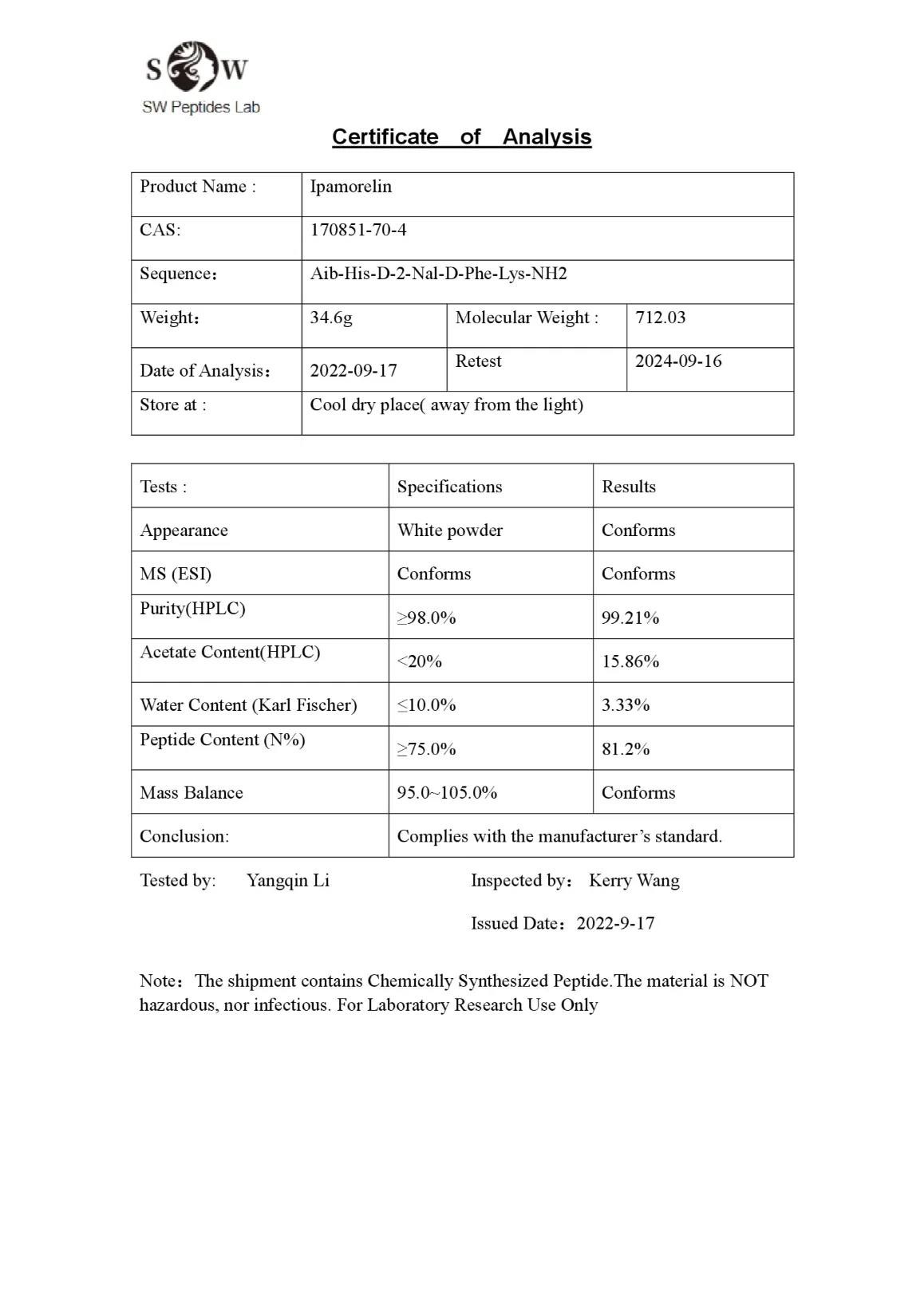
For laboratory research use only. Not for human consumption.