
Disclaimer — For Research Use Only. This article is a scientific overview of sermorelin as a research compound, intended for qualified professionals studying the growth-hormone axis in vitro and in preclinical models. It is not medical or veterinary guidance. Sermorelin offered as a research compound is not a pharmaceutical product, is not for human or animal consumption, and nothing here should be read as a description of human use, dosing, or therapeutic effect.
Key Takeaways
- Sermorelin is GHRH(1-29)NH₂ — the first 29 amino acids of human growth-hormone-releasing hormone, and the shortest fragment that retains the full GH-releasing activity of the native 44-residue hormone.
- It acts as an agonist at the GHRH receptor (GHRHR) on pituitary somatotrophs, signalling through the Gs/cAMP/PKA pathway to drive growth-hormone synthesis and release in preclinical models.
- Like native GHRH, sermorelin is rapidly degraded by dipeptidyl peptidase-IV (DPP-IV), which removes its N-terminal dipeptide — a key reason it has a short half-life and why later analogs were engineered for stability.
- Sermorelin belongs to the GHRH-analog class (with tesamorelin and CJC-1295), mechanistically distinct from the growth-hormone secretagogues (ipamorelin, GHRP-2/6, hexarelin) that act on a different receptor.
- It is a long-standing reference tool for studying GHRH-receptor pharmacology and GH-axis regulation in the laboratory.
What Is Sermorelin?
Sermorelin is a synthetic peptide corresponding to the N-terminal 29 amino acids of human growth-hormone-releasing hormone (GHRH), also written GRF(1-29)NH₂. Human GHRH was originally isolated and sequenced in 1982 as a 44-amino-acid peptide from pancreatic tumours that had caused acromegaly. [1][2] Subsequent work established that the biological activity of the full hormone resides in its N-terminal region, and that the 1-29 fragment is the shortest synthetic peptide that retains the full GH-releasing activity of GHRH. [3] That property — full activity in a smaller, more tractable molecule — is what made sermorelin a durable reference compound for GH-axis research.
Molecular profile (free base):
| Sequence (1-letter) | YADAIFTNSYRKVLGQLSARKLLQDIMSR-NH₂ |
| Length | 29 amino acids (C-terminal amide) |
| Molecular formula | C₁₄₉H₂₄₆N₄₄O₄₂S |
| Molecular weight | ~3,357.9 g/mol |
| CAS (free base) | 86168-78-7 |
| PubChem CID | 16132413 |
(The acetate salt is a distinct form with its own CAS and slightly different mass; the figures above are for the free base.) [4]
Mechanism of Action (Research Context)
Sermorelin is an agonist at the growth-hormone-releasing-hormone receptor (GHRHR), a class B (secretin-family) G-protein-coupled receptor expressed on the somatotroph cells of the anterior pituitary. Receptor activation couples through Gαs to adenylyl cyclase, raising intracellular cAMP and activating protein kinase A (PKA). Downstream, this stimulates the transcriptional programme governing growth-hormone synthesis (via CREB phosphorylation and the pituitary transcription factor Pit-1) and promotes calcium-dependent release of stored GH. [3]
Two features make sermorelin useful as a research tool rather than a blunt stimulus. First, because it works upstream at the GHRH receptor, the GH output it elicits in a model system remains subject to the body’s own regulatory feedback — notably somatostatin tone and IGF-1 feedback — so it engages the axis in a comparatively physiological, pulsatile manner rather than overriding it. [3] Second, it is highly receptor-specific, which is exactly what a researcher wants when probing GHRH-receptor pharmacology in isolation.
Pharmacology Relevant to Handling and Study Design
A defining characteristic of sermorelin — and of native GHRH — is rapid enzymatic degradation. The serine protease dipeptidyl peptidase-IV (DPP-IV / CD26) removes the N-terminal Tyr¹-Ala² dipeptide (cleaving the Ala²–Asp³ bond), converting the peptide into a biologically inactive N-terminally truncated metabolite. [5] In plasma studies of GHRH(1-44), this N-terminal clipping drove a short functional half-life on the order of minutes, even though immunoreactivity persisted longer. [5]
This single fact explains a great deal about the GHRH-analog landscape and about study design:
- It is why sermorelin has a short half-life, a variable researchers must account for in time-course work.
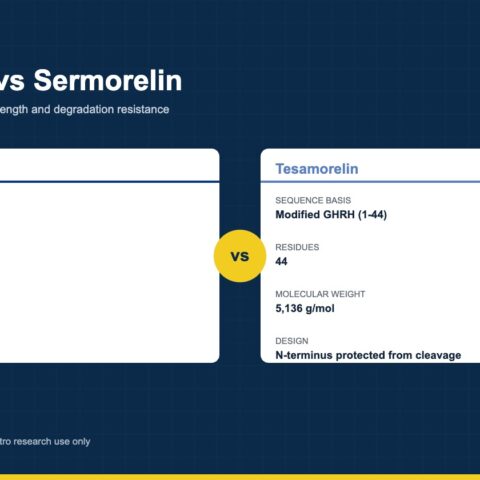
- It is why later analogs were engineered for DPP-IV resistance. Tesamorelin, for example, is the full GHRH(1-44) sequence bearing an N-terminal trans-3-hexenoyl group that sterically blocks DPP-IV cleavage, extending its half-life while preserving receptor binding. CJC-1295 uses a different strategy (bioconjugation/affinity approaches) to prolong activity.
- It informs handling: like other lyophilized research peptides, sermorelin should be reconstituted and stored carefully to preserve integrity (see our companion guide, How to Reconstitute Research Peptides).
Where Sermorelin Sits Among GH-Axis Research Peptides
Researchers studying growth-hormone release work with two mechanistically distinct families of peptides that converge on the same endpoint:
- GHRH analogs — sermorelin, tesamorelin, CJC-1295 — act on the GHRH receptor via the Gs/cAMP/PKA pathway described above.
- Growth-hormone secretagogues (GHS / ghrelin mimetics) — ipamorelin, GHRP-2, GHRP-6, hexarelin — act on a different receptor, the GHS-R1a (ghrelin receptor), signalling primarily through the Gq/phospholipase-C/IP₃/calcium pathway. [6]
Because the two classes engage two separate receptors that both feed into GH release, they are frequently studied side by side, and co-activation of both pathways has been reported to produce more-than-additive GH output in model systems — a major reason GHRH analogs and secretagogues are investigated together. [6] Within that landscape, sermorelin is the canonical, minimal GHRH-receptor agonist: a clean pharmacological starting point against which the stabilized analogs and the secretagogues can be compared.
A Note on Regulatory History (and Why Framing Matters)
Sermorelin has a notable regulatory history: as sermorelin acetate, it was previously marketed as a pharmaceutical product (brand name Geref) and was used clinically, before the manufacturer discontinued it around 2008 for commercial reasons — a business decision, not a withdrawal for safety or effectiveness. [3] It is important to be precise about what that means in a research setting: a peptide supplied for research use only is not a pharmaceutical product, carries no clinical indication, and is intended solely for in-vitro and preclinical laboratory study by qualified professionals. This profile therefore deliberately avoids any discussion of human dosing, administration, or therapeutic outcomes, and confines itself to molecular and mechanistic science.
Research Applications (In-Vitro / Preclinical)
In a laboratory setting, sermorelin is used as a tool to:
- characterize GHRH-receptor binding, activation, and signalling (cAMP/PKA readouts) in cell-based systems;
- probe GH-axis regulation — the interplay of GHRH input with somatostatin and IGF-1 feedback — in preclinical models;
- serve as a reference GHRH agonist when evaluating the pharmacology of stabilized analogs (tesamorelin, CJC-1295) or comparing GHRH-receptor versus GHS-R1a pathways;
- support assay development and receptor-pharmacology method work.
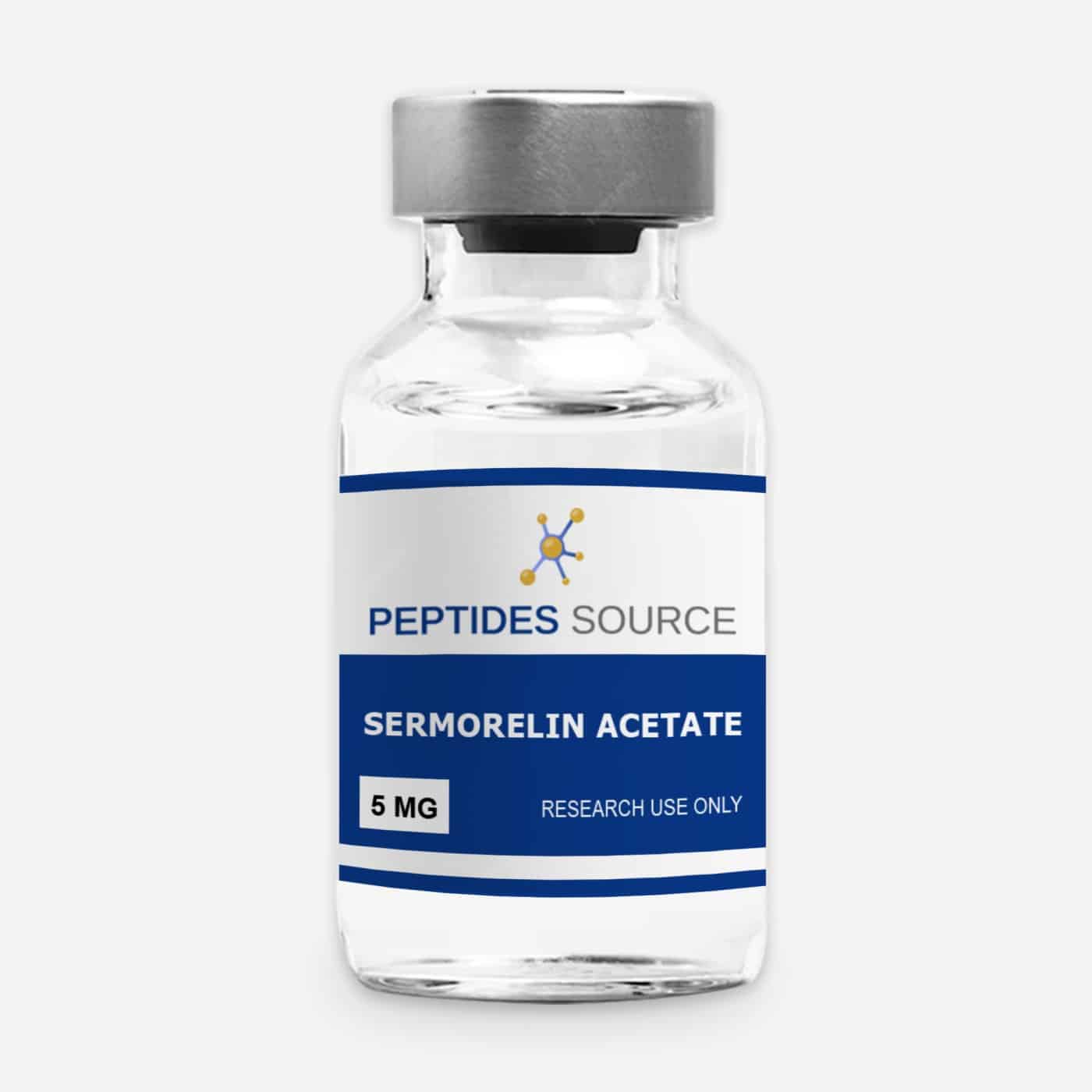
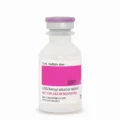
All such work assumes a qualified-researcher, in-vitro/preclinical context and appropriate handling of the lyophilized compound. Peptides Source supplies Sermorelin Acetate 5mg and Sermorelin Acetate 10mg for laboratory research, alongside related compounds in the Musculoskeletal & Growth Factor Research category.
Frequently Asked Questions
What is sermorelin?
Sermorelin is a synthetic 29-amino-acid peptide, GHRH(1-29)NH₂ — the N-terminal fragment of human growth-hormone-releasing hormone and the shortest fragment that keeps the hormone’s full GH-releasing activity in research models.
How does sermorelin work at the molecular level?
It is an agonist at the GHRH receptor on pituitary somatotrophs, signalling through Gαs/adenylyl cyclase/cAMP/PKA to stimulate growth-hormone synthesis and release in preclinical systems, while remaining subject to somatostatin and IGF-1 feedback.
How is sermorelin different from ipamorelin or CJC-1295?
Sermorelin and CJC-1295 are GHRH-receptor agonists (GHRH analogs); ipamorelin is a growth-hormone secretagogue that acts on the separate GHS-R1a (ghrelin) receptor. They reach GH release through different receptors and signalling pathways.
Why does sermorelin have a short half-life?
It is rapidly cleaved by the enzyme DPP-IV, which removes its N-terminal dipeptide and inactivates it — the same vulnerability that later analogs such as tesamorelin were engineered to resist.
Is sermorelin a drug?
A sermorelin compound supplied for research use only is not a pharmaceutical product and has no clinical indication. Although sermorelin acetate was formerly marketed as a medicine (Geref, since discontinued for commercial reasons), research-use material is intended solely for laboratory study and not for human or animal use.
References
- Guillemin R, Brazeau P, Böhlen P, Esch F, Ling N, Wehrenberg WB. “Growth hormone-releasing factor from a human pancreatic tumor that caused acromegaly.” Science. 1982;218(4572):585–587. PMID: 6812220.
- Rivier J, Spiess J, Thorner M, Vale W. “Characterization of a growth hormone-releasing factor from a human pancreatic islet tumour.” Nature. 1982;300(5889):276–278. PMID: 6292724.
- Prakash A, Goa KL. “Sermorelin: a review of its use in the diagnosis and treatment of children with idiopathic growth hormone deficiency.” BioDrugs. 1999;12(2):139–157. PMID: 18031173.
- PubChem. Sermorelin, CID 16132413 (molecular formula, weight, CAS). National Center for Biotechnology Information.
- Frohman LA, Downs TR, Williams TC, Heimer EP, Pan YC, Felix AM. “Rapid enzymatic degradation of growth hormone-releasing hormone by plasma in vitro and in vivo to a biologically inactive product cleaved at the NH₂ terminus.” J Clin Invest. 1986;78(4):906–913. PMID: 3093533.
- Ishida J, et al. “Growth hormone secretagogues: history, mechanism of action, and clinical development.” JCSM Rapid Communications. 2020;3(1):25–37. doi:10.1002/rco2.9.
For Research Use Only. Not for human or animal consumption. This material is intended solely for in-vitro and preclinical laboratory research by qualified professionals and is not a drug, food, cosmetic, or dietary supplement. Nothing herein describes or implies human or veterinary use, dosing, or therapeutic effect.