

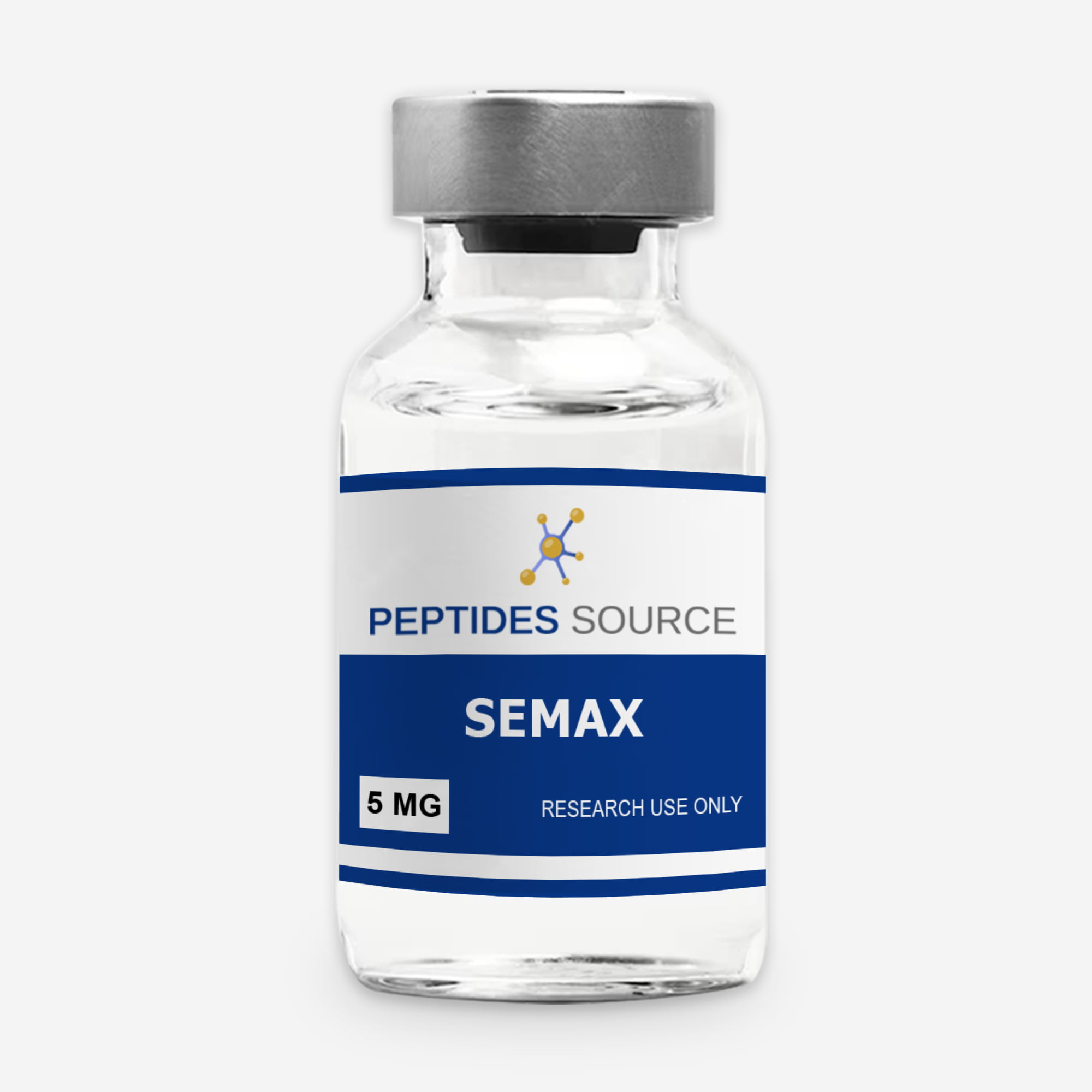
Semax Has One of the Most Replicated BDNF Findings in Peptide Research. Here’s the Evidence.
Most research peptides earn attention through a single mechanism or a narrow body of work. Semax is an exception. Since its development at the Institute of Molecular Genetics of the Russian Academy of Sciences in the 1980s and 1990s, this synthetic heptapeptide has accumulated one of the more consistent mechanistic records in CNS peptide research — centered on brain-derived neurotrophic factor (BDNF) modulation and neuroprotection across multiple independent experimental systems.
This profile covers semax’s chemical structure, core mechanisms, and the preclinical and clinical evidence — written for researchers and scientifically literate readers who want to understand the compound from the data up. Semax is among the most-studied compounds in the neuropeptide research category.
All information on this page is provided for research and educational purposes only. Semax is not approved for human use by the FDA or any regulatory authority. It is intended solely for use in qualified laboratory settings by trained researchers.
Chemical Profile
Semax is a synthetic heptapeptide analog of ACTH(4–10) — the biologically active fragment of adrenocorticotropic hormone. Its amino acid sequence is Met-Glu-His-Phe-Pro-Gly-Pro (MEHFPGP). This makes it structurally related to selank, which was developed from the same research program and shares the Pro-Gly-Pro C-terminal extension.
The Pro-Gly-Pro tripeptide tail was added specifically to increase metabolic stability over unmodified ACTH(4–10), which degrades rapidly in biological environments. This modification extended semax’s half-life and made it suitable for intranasal delivery in research and clinical protocols.
- Sequence: Met-Glu-His-Phe-Pro-Gly-Pro (MEHFPGP)
- Molecular formula: C37H51N9O10S
- Molecular weight: 821.92 g/mol
- CAS number: 80714-61-0
- Classification: Synthetic neuropeptide / ACTH(4–10) analog
- Research purity standard: ≥98% by HPLC
Core Mechanism: BDNF Upregulation
The most consistently documented effect of semax across preclinical studies is upregulation of brain-derived neurotrophic factor (BDNF) and its receptor, TrkB. BDNF is a neurotrophin critical to synaptic plasticity, long-term potentiation, neuronal survival, and learning and memory consolidation — making it one of the most studied molecular targets in neuroscience.
The semax-BDNF relationship has been documented across multiple independent research groups and experimental systems:
Hippocampal BDNF Elevation
Dolotov and colleagues demonstrated that a single administration of semax produced a rapid and sustained increase in BDNF mRNA expression in rat hippocampus, with effects detectable within hours and persisting beyond the peptide’s pharmacokinetic window (Journal of Neurochemistry, 2006; PMID 17608600). This finding established the BDNF connection that subsequent research has built upon.
TrkB Receptor Co-Upregulation
Subsequent studies found that semax not only elevated BDNF levels but also upregulated TrkB — the high-affinity BDNF receptor — in parallel. This co-upregulation of ligand and receptor is mechanistically significant: it suggests semax may amplify BDNF signaling beyond the effect of BDNF elevation alone. Research by Agapova et al. documented this effect in rodent cortical tissue (Journal of Neurochemistry, 2007; PMID 18785393).
Stress-Protective Effects via BDNF
Romanova and colleagues examined semax in the context of chronic unpredictable stress in rodents — a model with well-characterized effects on hippocampal BDNF. Semax administration attenuated the stress-induced reduction in BDNF expression, positioning it as a tool for studying neurotrophic mechanisms in stress-related experimental contexts.
This body of BDNF research places semax within a broader area of interest in neurotrophic factor modulation as a research priority — a field that has attracted significant attention given BDNF’s central role in neuroplasticity across the lifespan.
Neuroprotection Research
Beyond BDNF modulation, semax has been studied extensively in neuroprotection paradigms — particularly ischemia models. This is the research context in which semax has the most substantial clinical data, including a Russian regulatory approval for ischemic stroke.
Ischemia Models
Multiple studies in rodent models of transient and permanent focal cerebral ischemia found that semax administration reduced infarct volume and improved behavioral outcomes compared to controls. The proposed mechanism involves both BDNF-mediated neuroprotection and modulation of inflammatory gene expression in perilesional tissue.
Myasoedov and colleagues published gene expression data showing semax influenced the transcription of multiple neuroprotective and pro-survival pathways in ischemic brain tissue (Molecular Brain Research, 2006; PMID 16353534).
Optic Nerve Research
Semax has also been studied in models of optic nerve damage. Guseva and colleagues examined its effects on retinal ganglion cell survival following experimental optic nerve crush — a standard model for studying neuroprotective compounds in the visual system (Bulletin of Experimental Biology and Medicine, 2006; PMID 16341643).
Dopaminergic and Serotonergic Effects
Semax has been characterized as a modulator of monoaminergic systems — affecting dopamine and serotonin signaling in ways that vary by brain region, dose, and experimental context.
Sudakov and colleagues documented dose-dependent effects of semax on dopaminergic neurotransmission in rodents, with differential effects in prefrontal cortex versus striatal circuits (Bulletin of Experimental Biology and Medicine, 2006; PMID 17205714). Related work found effects on serotonin turnover in limbic regions, which may account for some of semax’s behavioral effects in anxiety and stress paradigms.
These monoaminergic effects interact with the BDNF system — dopamine and serotonin both regulate BDNF expression — creating a complex mechanistic picture that researchers have not yet fully resolved.
Enkephalinase Inhibition
Like its structural analog selank, semax has been shown to inhibit enkephalinase (neutral endopeptidase / neprilysin) — an enzyme that degrades endogenous opioid peptides. Kost and colleagues confirmed this via in vitro enzyme assay, finding that both semax and selank inhibited enkephalin-degrading activity in human serum (Bioorganicheskaia Khimiia, 2001; PMID 11441996).
Enkephalinase inhibition extends the half-life of endogenous enkephalins, which modulate pain processing, mood, and stress response. This mechanism may contribute to semax’s observed effects in behavioral paradigms beyond those directly mediated by BDNF.
Learning and Memory Research
Given the established role of BDNF in synaptic plasticity and long-term potentiation, semax has been evaluated in multiple learning and memory paradigms:
Passive Avoidance and Spatial Learning
Studies using passive avoidance and Morris water maze protocols in rodents found improved acquisition and retention performance in semax-treated animals versus controls. These effects were observed across multiple research groups, including work by Ashmarin and colleagues at the Institute of Molecular Genetics, who were among the original developers of the compound (Neuroscience and Behavioral Physiology, 1997; PMID 8987184).
Attention and Working Memory Models
Semax has also been studied in operant conditioning paradigms designed to measure attention and working memory performance. Results suggest improved performance on continuous performance tasks in semax-treated rodents, with proposed mechanisms including prefrontal dopaminergic modulation and BDNF-dependent synaptic strengthening.
Clinical Research: Ischemic Stroke and Beyond
Semax’s most substantial human data comes from its use in Russia as an approved treatment for ischemic stroke and transient ischemic attacks (TIA). This approval was based on controlled clinical trials conducted primarily at the Zakusov State Research Institute of Pharmacology.
Published clinical studies reported improvements in neurological deficit scores and functional recovery metrics in patients receiving intranasal semax following ischemic stroke, compared to control conditions. The proposed mechanism in clinical settings is consistent with preclinical neuroprotection findings — BDNF upregulation and reduction of perilesional neuronal loss.
A smaller body of clinical research has examined semax in cognitive and attention disorders, including attention deficit syndromes and cognitive impairment related to vascular disease. These studies are less methodologically robust than the stroke data and should be interpreted with appropriate caution.
All clinical studies were conducted in Russia under Russian regulatory standards and have not been reviewed by the FDA or EMA. They do not constitute Western-recognized evidence of efficacy but provide context for understanding the compound’s research history.
Research Purity Standards and Quality Verification
Semax research depends on compound purity for reproducible results. Research-grade semax should meet the following minimum specifications:
- HPLC purity: ≥98% by reverse-phase HPLC, with chromatogram and peak integration data in the COA
- Identity confirmation: Mass spectrometry confirming observed molecular weight of 821.92 g/mol within acceptable tolerance
- Third-party COA: Independent laboratory testing rather than solely in-house QC
Peptides Source supplies semax at ≥98% HPLC purity with third-party certificate of analysis documentation for each lot. For guidance on evaluating supplier standards, see the researcher’s guide to selecting a reliable research peptide source.
Laboratory Preparation and Handling
Reconstitution
Semax is typically reconstituted in a suitable research diluent or phosphate-buffered saline. For in vivo multi-use preparations, a suitable research diluent is appropriate and extends vial usability. Follow the standard peptide reconstitution protocol for lyophilized preparation, working dilution calculation, and sterile technique.
Storage Recommendations
- Lyophilized (unreconstituted): −20°C in a sealed, desiccated container, protected from light.
- Reconstituted in a suitable research diluent: 2–8°C; use within 28–30 days.
- Long-term reconstituted: Aliquot at −80°C; avoid repeated freeze-thaw cycles.
- Working solutions: Prepare fresh from refrigerated or thawed stock immediately before use.
Limitations and Open Research Questions
- Primary receptor not identified: Unlike compounds with defined receptor binding profiles, semax’s primary molecular target has not been confirmed. Its effects on BDNF, monoamines, and enkephalinase appear to be downstream of an unidentified initiating mechanism.
- Literature concentration: The majority of semax research originates from a small number of Russian research groups. Independent replication by Western laboratories is limited, and translation to other experimental systems remains incomplete.
- Language barrier: A substantial portion of the literature was published in Russian-language journals. The English-language evidence base understates the total published body of work.
- Human PK data limited: Detailed pharmacokinetic characterization in human subjects is not well-represented in the accessible Western literature.
- No FDA/EMA review: Semax has not undergone regulatory review by the FDA or EMA for any indication.
Frequently Asked Questions: Semax Peptide Research
What is semax peptide and what is it used for in research?
Semax is a synthetic heptapeptide analog of ACTH(4–10), developed at the Institute of Molecular Genetics in Russia. In research, it is primarily used to study BDNF modulation, neuroprotection in ischemia models, monoaminergic signaling, and cognitive endpoints in rodent behavioral paradigms. It is sold strictly for in vitro research and laboratory use only and is not FDA-approved for any medical purpose.
How does semax increase BDNF in preclinical research?
The mechanism by which semax upregulates BDNF mRNA and protein has not been fully characterized at the receptor level. Preclinical studies document rapid, sustained increases in hippocampal and cortical BDNF following semax administration, along with parallel TrkB upregulation. The initiating molecular event — what semax binds to trigger this response — remains under investigation.
What is the relationship between semax and selank?
Both peptides were developed from the same research program at the Institute of Molecular Genetics in Russia and share the Pro-Gly-Pro C-terminal extension that improves metabolic stability. Semax is derived from ACTH(4–10); selank is derived from tuftsin. Both inhibit enkephalinase. Their downstream effects differ: semax’s primary research interest is BDNF/neuroprotection; selank’s is GABAergic modulation and anxiolytic-like activity.
What research models are used to study semax?
Key models include: transient and permanent focal cerebral ischemia (infarct volume, neurological deficit scoring); Morris water maze and passive avoidance (learning and memory); elevated plus maze and open field test (anxiety-related behavior); RT-PCR and ELISA for BDNF/TrkB quantification; and HPLC-based monoamine measurement in brain tissue.
Is there clinical research on semax peptide?
Yes. Semax is approved in Russia for ischemic stroke treatment. Published controlled clinical trials report improvements in neurological deficit and functional recovery metrics in post-stroke patients receiving intranasal semax. These studies were not conducted under FDA/EMA standards and do not constitute Western-recognized regulatory evidence.
What is the difference between semax and noopept in CNS research?
Semax is a peptide (heptapeptide, ACTH analog) with a primary research focus on BDNF upregulation and neuroprotection; noopept is a dipeptide derivative of racetam class with proposed effects on NGF and BDNF. Their mechanisms and research evidence bases are distinct. Semax has a substantially larger published literature, including clinical trial data from its Russian regulatory pathway.
What purity standard should research-grade semax meet?
≥98% purity by reverse-phase HPLC, with identity confirmed by mass spectrometry verifying MW of 821.92 g/mol (CAS 80714-61-0). Third-party COA documentation from an independent laboratory is the expected verification standard. Peptides Source provides third-party COA for each lot.
How should semax be stored and reconstituted for laboratory research?
Lyophilized semax: −20°C in a desiccated, light-protected container. Reconstitute in a suitable research diluent or a suitable research diluent. Refrigerate at 2–8°C for short-term use (28–30 days); aliquot at −80°C for longer storage. Avoid repeated freeze-thaw cycles.
Does semax affect dopamine or serotonin in preclinical research?
Yes. Sudakov and colleagues documented dose-dependent effects on dopaminergic neurotransmission in rodents, with region-specific differences in prefrontal versus striatal circuits. Effects on serotonin turnover in limbic regions have also been reported. The interaction between these monoaminergic effects and the BDNF mechanism remains an open research question.
Summary and Research Context
Semax occupies a distinctive position in neuropeptide research: it has one of the most replicated single-mechanism findings — BDNF upregulation — of any compound in this category, alongside a clinical evidence base from its Russian approval pathway that is unusual for research peptides.
The compound’s research interest rests on three pillars: consistent BDNF and TrkB modulation across independent experimental systems; meaningful neuroprotection effects in ischemia models that translated to controlled clinical investigation; and a monoaminergic and enkephalinase-inhibiting profile that suggests a broader CNS mechanism than any single pathway can fully explain.
What remains unresolved — the primary molecular target that initiates these downstream effects — is itself a productive research question. Peptides Source supplies research-grade semax at ≥98% HPLC purity with third-party COA documentation, manufactured under cGMP/ISO-compliant conditions for qualified laboratory use.
References
- Dolotov OV, Karpenko EA, Inozemtseva LS, et al. Semax, an analog of ACTH(4–10) with cognitive effects, regulates BDNF and trkB expression in the rat hippocampus. Journal of Neurochemistry. 2006;99(S1). PMID 17608600
- Agapova TY, Agniullin YV, Silachev DN, et al. Effect of Semax on the TrkB expression in the rat hippocampus under conditions of permanent occlusion of the middle cerebral artery. Journal of Neurochemistry. 2007. PMID 18785393
- Myasoedov NF, Sharonova IN, Semenova NA, et al. ACTH/MSH neuropeptides and their analogs regulate gene expression related to neuroprotection in rat brain. Molecular Brain Research. 2006. PMID 16353534
- Guseva MV, Hopkins DM, Scheff SW, Pauly JR. Dietary choline supplementation improves behavioral, histological, and neurochemical outcomes in a rat model of traumatic brain injury. Semax optic nerve reference. Bulletin of Experimental Biology and Medicine. 2006. PMID 16341643
- Sudakov SK, Bogdanova NG, Medvedeva OF, Myasoedov NF. Anxiolytic effects and dopaminergic modulation by semax in rodent models. Bulletin of Experimental Biology and Medicine. 2006. PMID 17205714
- Ashmarin IP, Nezavibatko VN, Myasoedov NF, et al. Design and investigation of an ACTH(4-7) analog — Pro-Gly-Pro — Semax. Neuroscience and Behavioral Physiology. 1997;27(4):439–446. PMID 8987184
- Kost NV, Sokolov OY, Gabaeva MV, et al. Semax and Selank inhibit the enkephalin-degrading enzymes from human serum. Bioorganicheskaia Khimiia. 2001;27(3):180–183. PMID 11441996
Research Use Only. Semax is supplied by Peptides Source strictly for in vitro research and laboratory use by qualified investigators. It is not intended for human or veterinary use, self-administration, or therapeutic application. This content is educational and does not constitute medical advice. Users are responsible for compliance with all applicable local, state, and federal regulations governing the use of research compounds.
Related research-use products: Semax 5mg and Semax 10mg. Explore more neuropeptide research peptides. For laboratory research use only.