
All compounds discussed are intended strictly for in vitro research and laboratory use. Not for human or animal consumption.
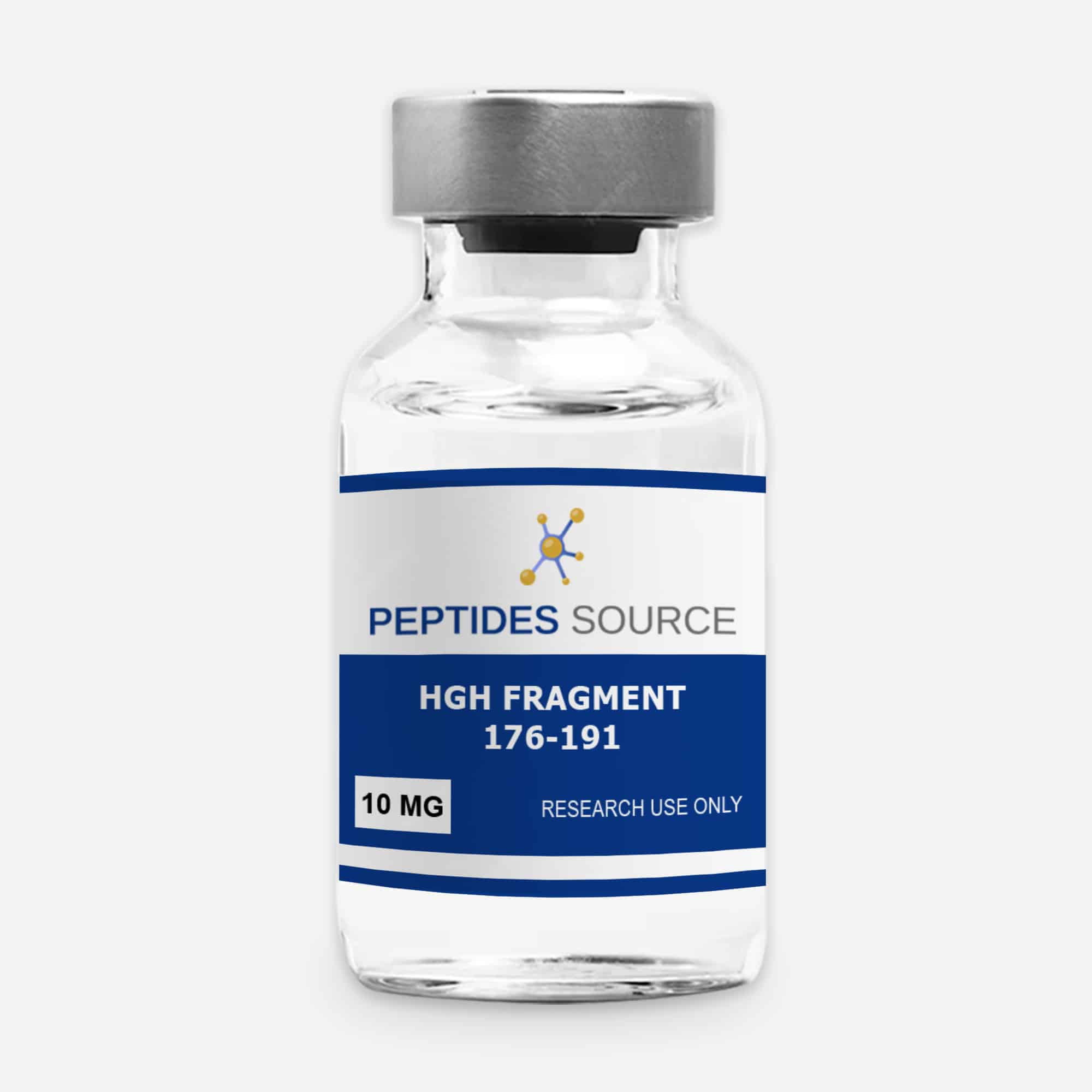
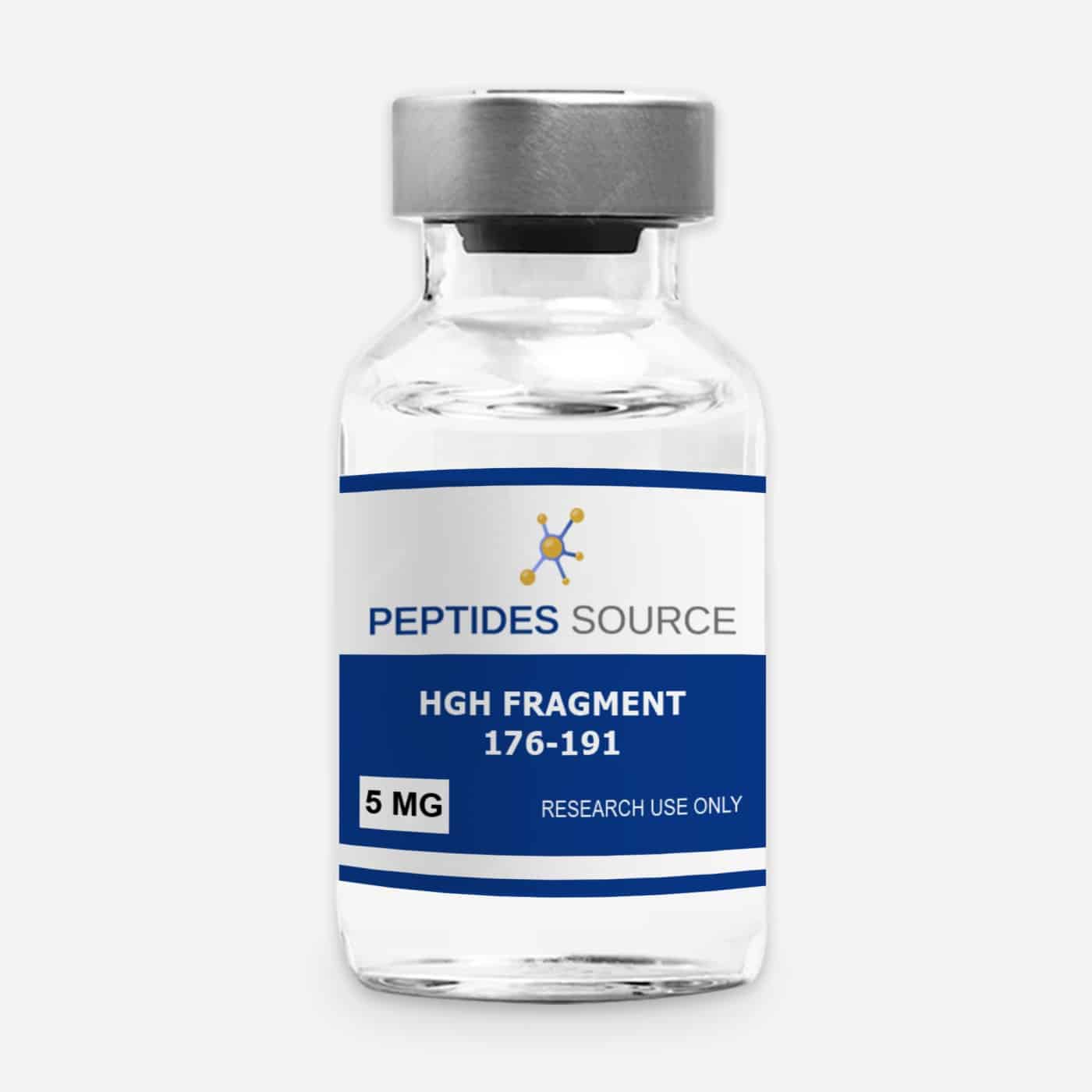
These two compounds are confused constantly, including on supplier certificates of analysis, and the confusion is understandable: they differ by a single amino acid. But that one residue changes the molecular mass by sixteen daltons, and a mass spectrometry result is the only thing on a certificate that tells them apart. This comparison sets out what each molecule is, exactly where they diverge, and how to read the paperwork. Both are supplied by Peptides Source for laboratory work, including the HGH Fragment 176-191 research vial. It describes molecular and research characteristics only, not outcomes in people.
The short version
- HGH Fragment 176-191 is residues 176 to 191 of human growth hormone: sixteen amino acids, cyclized by a disulfide bond between positions 7 and 14 of the fragment.
- AOD-9604 is a modified analog: the 177-191 span with an extra tyrosine added at the N-terminus. Also sixteen residues, but not the same sixteen.
- The mass difference is the tell. 1,799.1 against 1,815.1 g/mol in the cyclic form. A tyrosine residue is 163 daltons; removing Phe176 at 147 and adding Tyr nets +16.
- Neither is intact growth hormone, which is 191 residues and roughly 22,124 daltons, more than twelve times the mass.
- For research use only. Not for human or veterinary use or consumption.
Where the two molecules actually diverge
HGH Fragment 176-191 reproduces the C-terminal region of the growth hormone sequence exactly as it appears in the parent protein. Its sequence is Phe-Leu-Arg-Ile-Val-Gln-Cys-Arg-Ser-Val-Glu-Gly-Ser-Cys-Gly-Phe. Two cysteines, at positions 7 and 14 of the fragment, form a disulfide bond that closes a loop within the peptide.
AOD-9604 starts one residue later. It takes the 177-191 span, which drops the phenylalanine at 176, and adds a tyrosine at the N-terminus that is not present in the growth hormone sequence at all. The result is still a sixteen-residue peptide, and it retains the same internal disulfide loop, but its first residue is a synthetic addition rather than native sequence.
That is the entire structural difference. One native residue removed from the front, one non-native residue added in its place.
Molecular profiles
| Research criterion | HGH Fragment 176-191 | AOD-9604 |
|---|---|---|
| Relationship to growth hormone | Native residues 176 to 191 | Residues 177 to 191 plus an added N-terminal tyrosine |
| Residues | 16 | 16 |
| First residue | Phe (native) | Tyr (synthetic addition) |
| Molecular formula | C78H123N23O22S2 | C78H123N23O23S2 |
| Molecular weight, cyclic | 1,799.1 g/mol | 1,815.1 g/mol |
| Molecular weight, reduced linear | 1,801.1 g/mol | 1,817.1 g/mol |
| Disulfide bond | One, positions 7 to 14 | One, equivalent position |
| CAS number | 66004-57-7 | 221231-10-3 |
| PubChem CID | 16131230 | 71300630 |
| Form supplied | Lyophilized powder | Lyophilized powder |
The two formulas differ by exactly one oxygen atom, which is the hydroxyl on the tyrosine side chain. That is how close these molecules are.
Reading the mass: the trap on certificates of analysis
This is the practical heart of the comparison, and it is where most suppliers get it wrong.
Four different numbers circulate for these two compounds, and all four are correct for something. Which one a certificate should show depends on which molecule it is and whether the disulfide bond is formed:
- 1,799.1 is HGH Fragment 176-191 with its disulfide bond closed. This is what PubChem reports for CID 16131230 and it is the figure a correctly synthesized fragment should match.
- 1,801.1 is the same peptide in its reduced, linear form, with the disulfide broken. Two hydrogens heavier.
- 1,815.1 is AOD-9604, cyclic.
- 1,817.1 is AOD-9604, reduced.
The failure mode is specific and common: a certificate for a product sold as “HGH Fragment 176-191” reporting a mass near 1,815 or 1,817 is describing AOD-9604, not the fragment. Those are different molecules with different first residues.
So never accept a single dalton figure without knowing which form it describes. A certificate that states the mass and specifies whether the material is the cyclic or reduced form is doing its job. One that gives a bare number is not, and on this particular pair a bare number is genuinely ambiguous.
How both differ from intact growth hormone
Both compounds are frequently discussed as though they were versions of growth hormone. They are not, and the scale of the difference is worth stating in numbers.
Intact human growth hormone, somatropin, is 191 amino acids and roughly 22,124 daltons. It folds into a four-helix bundle stabilized by two disulfide bonds, and that fold builds the two surfaces it uses to bind and dimerize its receptor.
These fragments are sixteen residues and about 1,800 daltons, roughly one twelfth of the mass. Sixteen residues cannot form a four-helix bundle. Whatever a short C-terminal fragment does, it does not do it by reproducing the parent protein’s receptor-binding architecture, because that architecture requires the rest of the chain to exist.
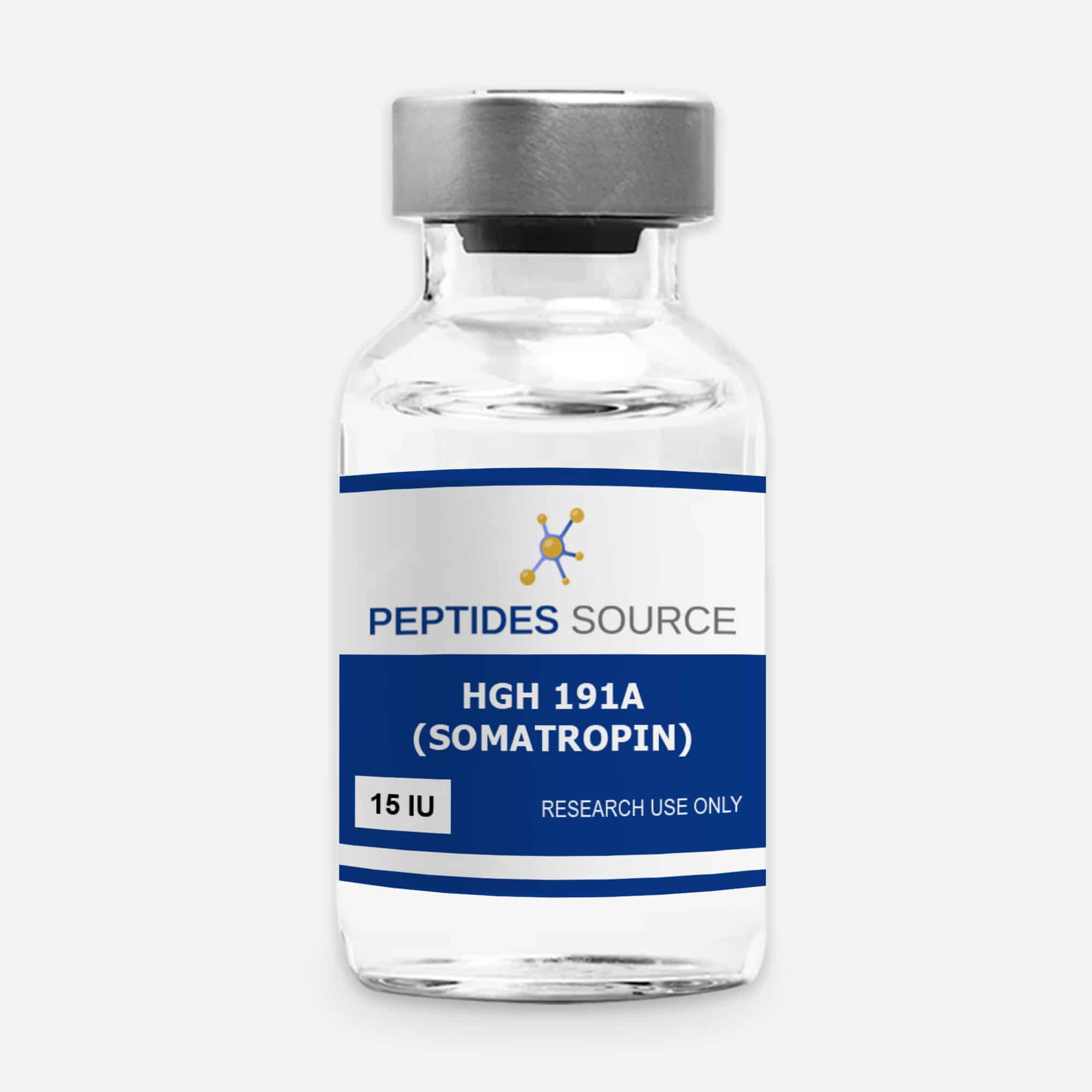
Our HGH 191AA (Somatropin) research overview covers the intact protein, how it signals, and how it is distinguished from both the fragments and the growth hormone secretagogues.
The research literature, and where it actually comes from
A point of genuine importance for anyone citing this area: much of the published work on the lipid-metabolism properties of this C-terminal region was carried out on AOD-9604 and its relatives, not on the 176-191 fragment itself.
The primary work on the synthetic C-terminal sequence was published by Wu and Ng (PMID 8358331), and subsequent molecular and cellular characterization in animal models was done on the modified analog (Ng et al., 2000). The conformational and structural analysis of the cyclic peptide from this domain was published separately (Ogru et al., 2000), and it is that work which underpins the disulfide-loop discussion above.
The practical consequence is that a claim sourced to the AOD-9604 literature is not automatically a claim about HGH Fragment 176-191. They are related compounds studied in overlapping programs, but they are not interchangeable, and a study design that cites one while using the other has a gap in it.
Choosing between them for a study
The choice follows from the structural difference.
Choose HGH Fragment 176-191 when the question concerns the native C-terminal sequence as it exists in growth hormone, or when the fragment needs to correspond exactly to a region of the parent protein.
Choose AOD-9604 when the experimental design calls for the specific modified analog the bulk of the published characterization was performed on, or when comparing native against modified sequence is itself the variable.
Use both when the object of study is the effect of the N-terminal substitution, since they differ in exactly that one respect.
Whichever is chosen, confirm the mass and the form on the batch certificate before use, because on this pair the paperwork is the only thing distinguishing the two.
Verification: what a certificate should tell you
- Purity verified by HPLC, with the figure recorded on a batch-specific certificate of analysis tied to your lot number
- Identity confirmed by mass spectrometry, with the form stated, cyclic or reduced, since the two differ by two daltons and the two compounds differ by sixteen
- Disulfide status, because a preparation in which the 7 to 14 bond has not formed is a different species from the cyclized product
- Third-party testing, independent of the supplier
- Documented sourcing, US-based, for traceability
Peptides Source supplies HGH Fragment 176-191 at 98 percent or higher purity by HPLC with third-party batch documentation. For the criteria to apply to any supplier, see our guide to choosing a reliable peptide source.
One naming caution while reading databases: the PubChem record for AOD-9604 carries the synonym “Tyr-somatostatin (177-191)”. That is a database naming error. The parent molecule is growth hormone, not somatostatin. The formula and mass on that record are correct; the synonym is not.
Handling in the laboratory
Both are supplied as lyophilized powders and reconstituted before study. For step-by-step technique see our research peptide reconstitution protocol.
- Reconstitution: use a diluent appropriate to the assay, commonly a suitable research diluent. Confirm solubility in the intended vehicle before preparing working solutions.
- Storage, lyophilized: sealed vial frozen at approximately -20 degrees Celsius, protected from light.
- Storage, reconstituted: refrigerated at 2 to 8 degrees Celsius, aliquoted to avoid repeated freeze-thaw cycles, used within a short window.
Because both carry a disulfide bond, reducing conditions matter. A reducing agent in the buffer will open the 7 to 14 loop and convert the cyclic peptide to its linear form, which is a different species with a different mass. Where the cyclic form is what the protocol requires, the buffer needs to be checked rather than assumed.
Both sit within the broader musculoskeletal and growth research category.
Frequently asked questions
What is the difference between HGH Fragment 176-191 and AOD-9604?
HGH Fragment 176-191 is residues 176 to 191 of human growth hormone, reproduced exactly. AOD-9604 is the 177-191 span with a tyrosine added at the N-terminus that does not appear in the growth hormone sequence. Both are sixteen residues, but not the same sixteen. The molecular weights are 1,799.1 and 1,815.1 g/mol respectively in the cyclic form.
Why do the molecular weights differ by 16 daltons?
Because AOD-9604 drops the phenylalanine at position 176, worth about 147 daltons, and adds a tyrosine, worth about 163. The net change is roughly plus 16. The molecular formulas differ by exactly one oxygen atom, which is the hydroxyl on the tyrosine side chain.
My certificate says 1,817 daltons. Is that HGH Fragment 176-191?
No. 1,817.1 is AOD-9604 in its reduced linear form. HGH Fragment 176-191 is 1,799.1 cyclic or 1,801.1 reduced. A product sold as the 176-191 fragment reporting a mass near 1,815 or 1,817 is describing the modified analog instead.
Is HGH Fragment 176-191 the same as HGH?
No, and the difference is large. Intact growth hormone is 191 amino acids and roughly 22,124 daltons, folded into a four-helix bundle with two disulfide bonds. The fragment is sixteen residues and about 1,800 daltons, roughly one twelfth the mass, and sixteen residues cannot form that fold.
Does HGH Fragment 176-191 have a disulfide bond?
Yes. Cysteines at positions 7 and 14 of the fragment form a single disulfide bond that closes an internal loop. The cyclic and reduced linear forms differ by two daltons, so the form should be stated on a certificate of analysis rather than left implicit.
Which compound does the published research actually use?
A substantial part of the characterization of this C-terminal region was performed on AOD-9604 and related modified analogs rather than on the 176-191 fragment itself. A claim sourced to that literature is therefore not automatically a claim about the native fragment, and a study design should be explicit about which molecule it used.
What purity should research-grade material meet?
Verified by HPLC at 98 percent or higher on a batch-specific certificate of analysis, with identity confirmed by mass spectrometry and the form stated, and tested by an independent third-party laboratory.
How are these stored and handled?
Supplied as lyophilized powders and reconstituted in the laboratory, typically in a suitable research diluent. Sealed vials frozen at approximately -20 degrees Celsius and protected from light; reconstituted material refrigerated at 2 to 8 degrees Celsius, aliquoted to avoid repeated freeze-thaw cycles. Reducing conditions will open the disulfide bond, so the buffer should be checked where the cyclic form is required.
References
- US National Library of Medicine, PubChem. Compound record: Somatotropin (176-191), CID 16131230.
- US National Library of Medicine, PubChem. Compound record: AOD-9604, CID 71300630.
- Wu Z, Ng FM. Antilipogenic action of synthetic C-terminal sequence 177-191 of human growth hormone. Biochem Mol Biol Int. 1993;30(1):187-196. PMID 8358331.
- Ng FM, Jiang WJ, Gianello R, et al. Molecular and cellular actions of a structural domain of human growth hormone (AOD9401) on lipid metabolism in Zucker fatty rats. J Mol Endocrinol. 2000;25(3):287-298. PMID 11116208.
- Ogru E, Wilson JC, Heffernan M, et al. The conformational and biological analysis of a cyclic anti-obesity peptide from the C-terminal domain of human growth hormone. J Pept Res. 2000;56(6):388-397. PMID 11152298.
Peptides Source supplies research compounds for in vitro and laboratory research only. Nothing on this page is a recommendation for human or veterinary use. All products are sold strictly for research purposes and are not for human or animal consumption. Must be 21+ to purchase.