



























































DISCLAIMER
FOR RESEARCH USE ONLY The content in this article is for educational and informational purposes only, based on published scientific literature. The compounds discussed are not FDA-approved for human or veterinary use and are strictly intended for in-vitro laboratory research by qualified professionals. Peptides Source does not endorse or support the use of these compounds outside of a controlled research environment. Nothing in this article constitutes medical advice.
Epithalon (Ala-Glu-Asp-Gly), also referred to as Epitalon or the AEDG peptide, is a synthetic tetrapeptide originally developed at the St. Petersburg Institute of Bioregulation and Gerontology under the direction of Vladimir Khavinson.
The compound was designed as a synthetic analog of epithalamin – a polypeptide fraction extracted from bovine pineal gland tissue – with the objective of reproducing the gland-derived preparation’s documented effects in a structurally defined, reproducible format suitable for controlled laboratory investigation.
Over the past two decades, Epithalon research has generated a distinctive body of preclinical literature spanning three interconnected domains: telomerase enzyme activation and telomere elongation in cell culture models, pineal gland function and melatonin secretion in aging animal models, and lifespan studies in rodent and invertebrate organisms.
This convergence of telomere biology and neuroendocrine research within a single four-amino-acid peptide has made Epithalon one of the more widely referenced compounds in the peptide biogerontology literature.
This article provides a research-focused examination of the Epithalon preclinical evidence, covering its structural relationship to pineal-derived preparations, the telomerase activation studies that form its most cited research area, and the animal longevity models in which it has been investigated. All content is presented within a research-use-only framework, and no therapeutic, health, or longevity claims are made or implied regarding human use.
Key Takeaways
- Epithalon is a synthetic tetrapeptide (Ala-Glu-Asp-Gly) developed as a defined analog of epithalamin, a bovine pineal gland extract studied in Russian biogerontology research since the 1970s.
- The most frequently cited Epithalon study documented induction of telomerase catalytic subunit (hTERT) expression and telomere elongation in human fetal fibroblast cell cultures.
- Animal longevity studies have reported associations between Epithalon administration and extended mean and maximum lifespan in several rodent strains and Drosophila melanogaster.
- Preclinical research in aging primate models has documented associations between Epithalon and restored nighttime melatonin secretion patterns.
- The majority of published Epithalon research originates from a single research group, and independent replication in Western laboratory settings remains limited.
From Epithalamin to Epithalon: Development of a Defined Tetrapeptide
The origins of Epithalon research are rooted in the broader Russian bioregulatory peptide tradition, which has investigated gland-derived peptide fractions since the 1970s. Epithalamin – the parent compound – was a crude polypeptide extract obtained from bovine pineal glands, studied for its observed associations with melatonin regulation and aging biomarkers in animal models (Khavinson, 2002).
While epithalamin generated considerable interest within Russian gerontology, its heterogeneous composition presented fundamental challenges for standardized research: batch variability, uncharacterized component profiles, and the inability to attribute observed effects to specific molecular entities.
Epithalon was developed to address these limitations. By identifying the tetrapeptide sequence Ala-Glu-Asp-Gly as the minimal active fragment capable of reproducing epithalamin’s documented effects on pineal function in rodent models, Khavinson’s group created a structurally defined compound amenable to standard peptide synthesis and quality control.
This transition from gland extract to synthetic tetrapeptide represented a methodological advance that enabled more controlled experimental designs, though it also raised questions about whether a four-amino-acid peptide could fully replicate the biological activity of a complex polypeptide mixture.
Telomerase Activation and Telomere Elongation Studies
The most frequently cited area of Epithalon research involves its documented relationship with telomerase enzyme activity. Khavinson et al. (2003) reported that addition of Epithalon to telomerase-negative human fetal fibroblast cultures was associated with three key observations: induced expression of the telomerase catalytic subunit (hTERT), activation of telomerase enzymatic activity, and elongation of telomeres as measured by terminal restriction fragment analysis (Khavinson et al., 2003).
This study remains the foundational reference in the Epithalon telomerase literature.
The significance of these findings within the broader context of telomere biology warrants careful consideration. Telomerase – the ribonucleoprotein enzyme responsible for maintaining telomere length – is silenced in most human somatic cells, and progressive telomere shortening with each cell division is a well-established hallmark of cellular aging.
The observation that a four-amino-acid exogenous peptide could reactivate hTERT transcription in telomerase-negative cells is a notable finding, though the molecular mechanism by which this reactivation occurs has not been fully characterized.
Chromatin Remodeling and Epigenetic Hypotheses
Khavinson et al. (2003) also reported that Epithalon was associated with chromatin remodeling in aging cell populations, specifically activation of heterochromatic regions that become progressively condensed during cellular senescence (Khavinson et al., 2003b). This observation has led to the hypothesis that Epithalon’s effects on telomerase expression may involve epigenetic mechanisms – specifically, modulation of chromatin accessibility at the hTERT promoter region.
More recent work has extended this epigenetic hypothesis to neurogenesis contexts, with Khavinson et al. (2020) reporting that the AEDG peptide was associated with altered gene expression and protein synthesis patterns during neuronal differentiation in cell culture models (Khavinson et al., 2020).
Researchers should note that the telomerase activation literature for Epithalon is concentrated in a small number of publications from a single research group. While the findings are internally consistent, independent replication by laboratories outside the Khavinson group – particularly using contemporary single-cell telomere measurement techniques and standardized hTERT expression assays – would substantially strengthen the evidentiary basis for this area of Epithalon research.
Pineal Gland Function and Melatonin Research
Given its origins as a pineal gland peptide analog, Epithalon’s relationship with pineal function and melatonin secretion has been a consistent area of investigation. Age-related decline in melatonin production is a well-documented phenomenon across mammalian species, characterized by diminished amplitude and altered timing of the circadian melatonin rhythm.
Several preclinical studies have examined whether Epithalon administration influences these age-related patterns.
Korenevsky et al. (2002) reported that Epithalon administration influenced pineal secretory patterns in stress-exposed rats during daytime hours, documenting altered melatonin output relative to untreated controls (Korenevsky et al., 2002).
In a primate model, Khavinson et al. (2004) administered Epithalon to aging rhesus monkeys and reported significant increases in nighttime plasma melatonin levels, with partial restoration of the circadian melatonin rhythm that had deteriorated with age (Khavinson et al., 2004).
The primate study is particularly notable within the Epithalon literature because it demonstrates the compound’s documented effects in a species more closely related to humans than the rodent models that dominate the field.
Mechanistic Questions in Pineal Regulation
The mechanism by which a tetrapeptide influences pineal gland function remains an open question. Khavinson’s bioregulatory peptide framework proposes that short peptides interact directly with DNA regulatory sequences, modulating transcription of genes involved in gland-specific function.
However, the specific molecular targets within pinealocytes – whether membrane receptors, transcription factors, or chromatin-level interactions – have not been conclusively identified. Researchers investigating pineal function alongside related research peptides such as DSIP should evaluate each compound’s neuroendocrine profile independently.
Animal Longevity Models
A series of rodent and invertebrate longevity studies form the third major pillar of the Epithalon research literature. Anisimov et al. (2003) conducted one of the most comprehensive lifespan studies, administering Epithalon to female SHR mice and reporting increases in both mean lifespan (13.5%) and maximum lifespan (13.9%) compared to untreated controls, alongside shifts in aging biomarkers including estrous cycle patterns and body temperature regulation (Anisimov et al., 2003).
In an earlier study using transgenic HER-2/neu mice – a strain predisposed to mammary adenocarcinoma – Anisimov et al. (2002) reported that Epithalon administration was associated with decelerated aging phenotypes and reduced incidence of spontaneous mammary tumors relative to controls (Anisimov et al., 2002a).
Separate work in senescence-accelerated mice documented associations between Epithalon and reduced frequency of chromosomal aberrations in bone marrow cells (Anisimov et al., 2002b).
Interpreting the Lifespan Data
These longevity findings are intriguing but require careful interpretation. The lifespan studies were conducted in specific inbred or transgenic mouse strains with defined genetic backgrounds, and the extent to which strain-specific results generalize to outbred populations or other species is an open question.
The transgenic tumor model results are particularly difficult to interpret in isolation, as any intervention that modifies the hormonal or metabolic environment of a cancer-predisposed strain could alter tumor incidence through mechanisms unrelated to aging per se.
Retinal Research
An additional line of investigation has examined Epithalon’s effects on retinal tissue. Khavinson et al. (2002) reported that administration of the tetrapeptide was associated with improved functional parameters in the retinas of Campbell rats with hereditary retinal degeneration, as measured by electroretinography (Khavinson et al., 2002).
This finding connects to the broader observation that the pineal gland and retina share developmental origins and transcriptional machinery – both derive from the same embryonic neuroepithelium and express overlapping sets of photoreceptor-related genes.
The retinal research remains a minor component of the overall Epithalon research literature but is methodologically notable because it employed functional electrophysiological endpoints rather than relying solely on molecular or histological markers. Researchers working with compounds studied in related longevity contexts, including MOTS-c and Thymosin Alpha-1, may find the retinal model relevant as an additional tissue-level readout for aging-related peptide research.
Research Limitations and Methodological Considerations
Several important limitations apply to the current body of Epithalon research that investigators should consider when evaluating the literature or designing new studies.
First, the geographic and institutional concentration of published research is pronounced. The overwhelming majority of Epithalon publications originate from the St. Petersburg Institute of Bioregulation and Gerontology and closely affiliated laboratories. Vladimir Khavinson appears as an author on virtually all foundational studies.
While this reflects the compound’s development history, the lack of independent replication by unaffiliated research groups is a significant constraint on the literature’s overall strength. This limitation is shared by several compounds in the neuropeptide research space, including Selank and Semax, though the concentration is particularly pronounced for Epithalon.
Second, the molecular mechanism linking a four-amino-acid peptide to hTERT transcriptional activation has not been elucidated at the receptor or signal transduction level. The proposed epigenetic mechanism – direct peptide-DNA interaction modulating chromatin accessibility – is a departure from conventional receptor-mediated peptide pharmacology and would benefit from validation using contemporary chromatin immunoprecipitation (ChIP) and ATAC-seq approaches.
Third, the pharmacokinetic profile of Epithalon has not been comprehensively published. As a small tetrapeptide, AEDG is presumably susceptible to rapid proteolytic degradation in vivo. The compound’s bioavailability, half-life, tissue distribution, and metabolic fate across species have not been systematically characterized, which complicates interpretation of in vivo studies and cross-study comparisons.
Fourth, the relationship between the in vitro telomerase findings and the in vivo longevity observations has not been mechanistically established. Whether the lifespan extensions observed in rodent models are mediated by telomerase reactivation, pineal function restoration, antioxidant effects, or other pathways remains an open and important question.
Sourcing and Purity Standards
Finally, all Epithalon available through US research suppliers is designated for research use only. Researchers should verify compound purity through independent Certificates of Analysis (COAs) and HPLC documentation, confirming ≥98% purity.
USA-made peptides manufactured under GMP-compliant conditions provide the batch-to-batch consistency essential for reproducible results in telomere biology and longevity research.
The State of Epithalon Research in Telomere Biology and Biogerontology
Epithalon occupies a distinctive niche within the peptide research landscape. Its documented associations with telomerase activation, pineal melatonin restoration, and extended lifespan in animal models represent a convergence of cellular, neuroendocrine, and organismal aging research within a single, structurally simple tetrapeptide.
The breadth of documented observations is notable, spanning from chromatin remodeling at the molecular level to lifespan extension at the whole-organism level.
At the same time, the field is constrained by its institutional concentration, limited independent replication, and unresolved mechanistic questions. For Epithalon research to advance to the level of evidence that the broader biogerontology community requires, three priorities stand out: independent replication of the telomerase findings using contemporary genomic techniques, comprehensive pharmacokinetic characterization across species, and mechanistic studies that connect the in vitro cellular observations to the in vivo physiological outcomes.
Laboratories sourcing Epithalon and related longevity research compounds should prioritize suppliers offering comprehensive purity documentation, batch-specific COAs, and transparent manufacturing standards. Detailed compound specifications are available through the Peptide Source research catalog.
FOR RESEARCH USE ONLY The content in this article is for educational and informational purposes only, based on published scientific literature. The compounds discussed are not FDA-approved for human or veterinary use and are strictly intended for in-vitro laboratory research by qualified professionals. Peptides Source does not endorse or support the use of these compounds outside of a controlled research environment. Nothing in this article constitutes medical advice.
Frequently Asked Questions
1. What is Epithalon, and how does it relate to epithalamin?
Epithalon (Ala-Glu-Asp-Gly) is a synthetic tetrapeptide developed as a structurally defined analog of epithalamin, a polypeptide fraction extracted from bovine pineal gland tissue.
While epithalamin is a heterogeneous mixture with batch-to-batch variability, Epithalon is a single, reproducible four-amino-acid sequence identified as the minimal fragment capable of reproducing epithalamin’s documented effects on pineal function in preclinical models.
2. What did the foundational telomerase study demonstrate?
Khavinson et al. (2003) reported that adding Epithalon to telomerase-negative human fetal fibroblast cultures was associated with induced expression of the telomerase catalytic subunit (hTERT), activation of telomerase enzymatic activity, and elongation of telomeres.
This remains the most cited study in the Epithalon literature, though the molecular mechanism by which a tetrapeptide reactivates hTERT transcription has not been fully characterized.
3. What lifespan effects have been observed in animal models?
Rodent longevity studies have reported that Epithalon administration was associated with increases in both mean (13.5%) and maximum (13.9%) lifespan in SHR mice. Additional studies in transgenic cancer-prone mice documented associations with decelerated aging phenotypes and reduced spontaneous tumor incidence.
These findings come from specific inbred strains and may not generalize across genetic backgrounds.
4. How does Epithalon relate to pineal gland function?
Epithalon was originally developed as a synthetic analog of a pineal gland extract. Preclinical studies in aging rhesus monkeys have documented associations between Epithalon administration and increased nighttime melatonin levels, with partial restoration of the age-related decline in circadian melatonin rhythm.
The precise mechanism by which the tetrapeptide influences pinealocyte function remains under investigation.
5. What quality standards should researchers consider when sourcing Epithalon?
Researchers should verify compound purity through independent Certificates of Analysis (COAs) and HPLC documentation, ideally confirming ≥98% purity.
Given Epithalon’s small molecular size and susceptibility to proteolytic degradation, structural integrity verification is particularly important. Sourcing from USA-made, GMP-compliant manufacturers with documented batch-to-batch consistency is recommended for reproducible research outcomes.
References
- Khavinson, V.Kh. (2002). Peptides and Ageing. Neuroendocrinology Letters, 23(Suppl 3), 11-144. https://pubmed.ncbi.nlm.nih.gov/12374906/
- Khavinson, V.Kh., Bondarev, I.E., & Butyugov, A.A. (2003). Epithalon peptide induces telomerase activity and telomere elongation in human somatic cells. Bulletin of Experimental Biology and Medicine, 135(6), 590-592. https://pubmed.ncbi.nlm.nih.gov/12937682/
- Khavinson, V.Kh., Lezhava, T.A., Monaselidze, J.R., et al. (2003b). Peptide Epitalon activates chromatin at the old age. Neuroendocrinology Letters, 24(5), 329-333. https://pubmed.ncbi.nlm.nih.gov/1464700
- Khavinson, V.Kh., Linkova, N.S., Bocharina, A.V., et al. (2020). AEDG peptide (Epitalon) stimulates gene expression and protein synthesis during neurogenesis: possible epigenetic mechanism. Molecules, 25(3), 609. https://pubmed.ncbi.nlm.nih.gov/32019204/
- Anisimov, V.N., Khavinson, V.Kh., Popovich, I.G., et al. (2003). Effect of Epitalon on biomarkers of aging, life span and spontaneous tumor incidence in female Swiss-derived SHR mice. Biogerontology, 4(4), 193-202. https://pubmed.ncbi.nlm.nih.gov/14501183
- Anisimov, V.N., Khavinson, V.Kh., Provinciali, M., et al. (2002a). Epithalon decelerates aging and suppresses development of breast adenocarcinomas in transgenic her-2/neu mice. Bulletin of Experimental Biology and Medicine, 134(2), 187-190. https://pubmed.ncbi.nlm.nih.gov/12459848/
- Anisimov, V.N., Khavinson, V.Kh., Mikhalsky, A.I., et al. (2002b). Effect of epithalon on the incidence of chromosome aberrations in senescence-accelerated mice. Bulletin of Experimental Biology and Medicine, 133(3), 274-276. https://pubmed.ncbi.nlm.nih.gov/12360351/
- Korenevsky, A.V., Milyutina, Y.P., Bukalyov, A.V., et al. (2002). Epitalon influences pineal secretion in stress-exposed rats in the daytime. Neuroendocrinology Letters, 23(5-6), 439-444. https://pubmed.ncbi.nlm.nih.gov/12500171
- Khavinson, V.Kh., Goncharova, N.D., & Lapin, B.A. (2004). Peptide correction of age-related pineal disturbances in monkeys. Advances in Gerontology, 14, 121-125. https://pubmed.ncbi.nlm.nih.gov/14743609/
- Khavinson, V.Kh., Razumovsky, M.I., Trofimova, S.V., et al. (2002). Pineal-regulating tetrapeptide epitalon improves eye retina condition in retinitis pigmentosa. Neuroendocrinology Letters, 23(4), 365-368. https://pubmed.ncbi.nlm.nih.gov/12195242/
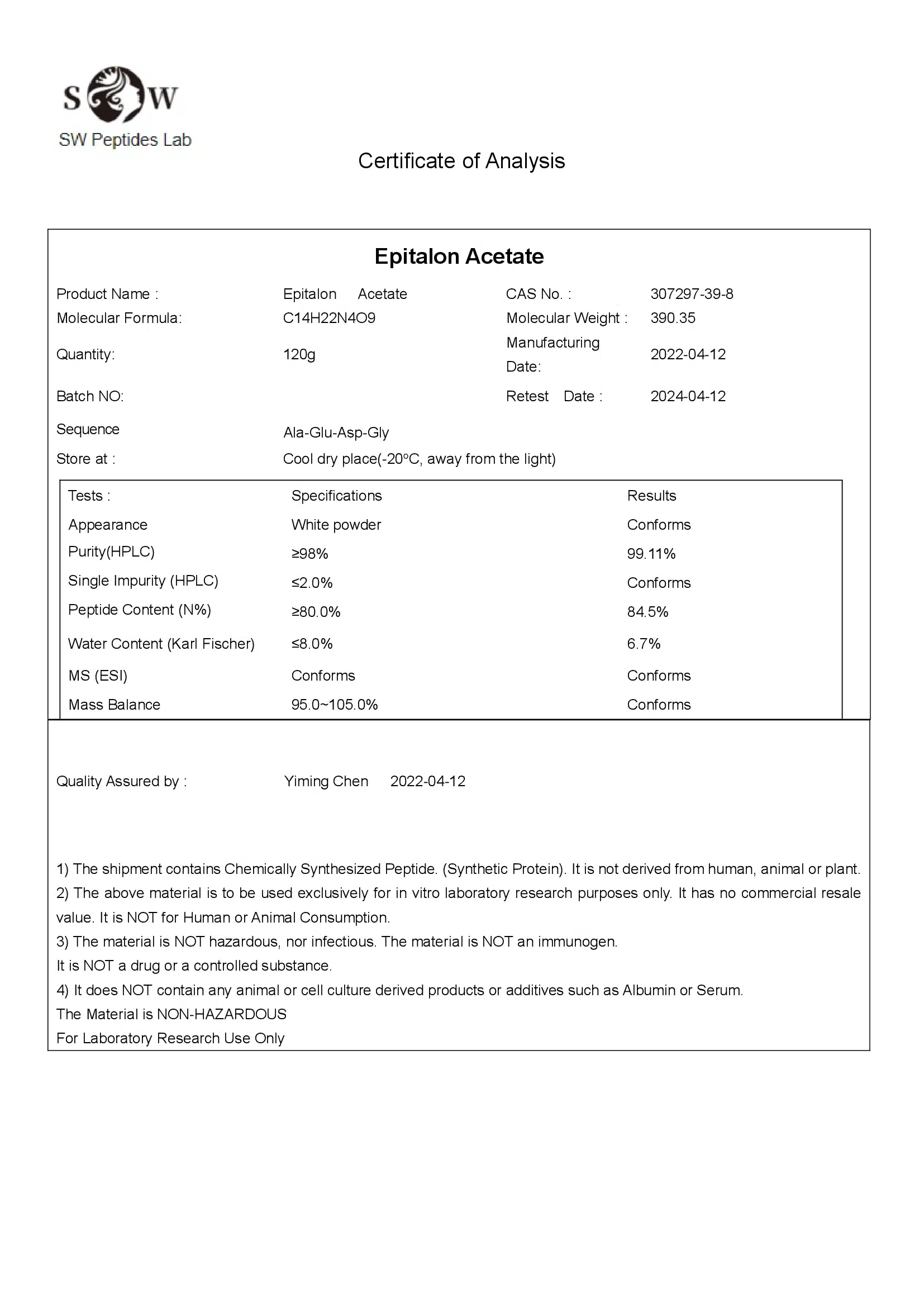
Certificate of Analysis (COA): Epithalon (Epitalon)
Each batch of this research compound is verified by an independent laboratory (SW Peptides Lab). The certificate of analysis below documents identity and purity. Key verified values:
- Purity (HPLC): 99.11% (specification: not less than 98%)
- Identity: MS (ESI) conforms; single impurity below 2.0%
- CAS number: 307297-39-8
- Molecular formula: C14H22N4O9 | Molecular weight: 390.35 | Sequence: Ala-Glu-Asp-Gly
- Peptide content: 84.5% | Water: 6.7%
- Appearance: white powder | Storage: cool, dry, -20°C, away from light
For laboratory research use only. Not for human consumption.