


All compounds discussed are intended strictly for in vitro research and laboratory use. Not for human or animal consumption.
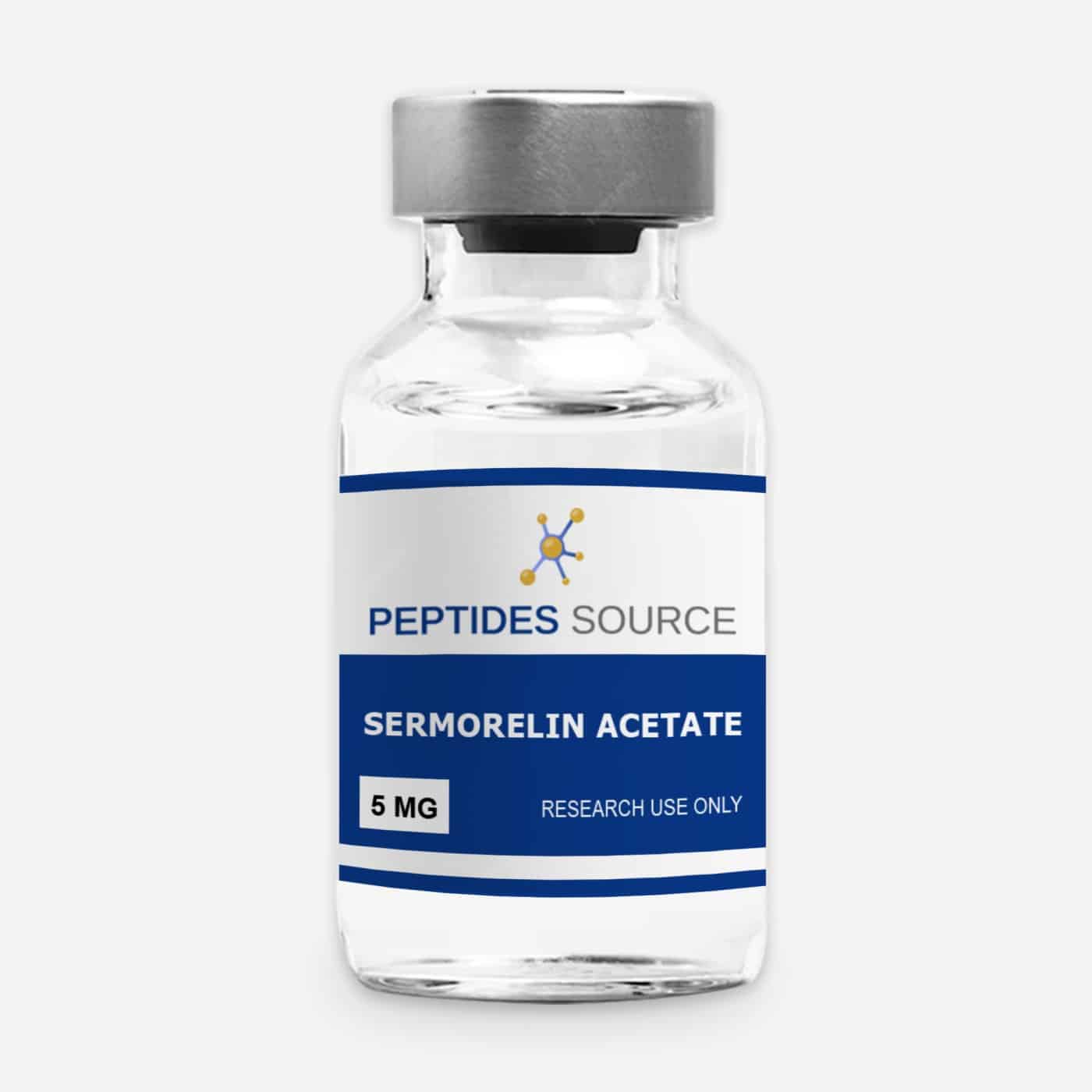
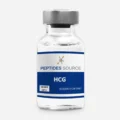
Tesamorelin and Sermorelin are the two most frequently compared analogs of growth-hormone-releasing hormone, and the comparison is usually settled with a single line about one being longer than the other. That is true, and it is not the useful part. The two molecules were designed to solve different problems, they have very different development histories, and those histories determine what a researcher can actually cite when using either one. Both are supplied by Peptides Source for laboratory work: the Tesamorelin research vial and the Sermorelin Acetate research vial.
This comparison sets out what each molecule is, how they differ structurally, what the difference means for stability and assay design, what the published literature establishes for each, and how a laboratory would choose between them. It describes molecular and research characteristics only, not outcomes in people.
The short version
- Both act at the same receptor. Sermorelin and Tesamorelin are both GHRH-receptor agonists. Unlike a GHRH-analog versus secretagogue comparison, this is not a two-receptor story.
- The difference is length and stabilization. Sermorelin is the first 29 amino acids of GHRH, the shortest fragment that keeps full activity. Tesamorelin is the full 44-residue sequence with a chemical group added to the N-terminus to slow degradation.
- Their evidence bases are very different sizes. Tesamorelin has a large controlled human trial literature behind it. Sermorelin’s record is older and centers on pediatric growth hormone deficiency and on diagnostic testing of growth hormone reserve.
- Neither is better. Sermorelin is the cleaner minimal-sequence baseline. Tesamorelin is the tool when analog stability is itself the variable.
- For research use only. Not for human or veterinary use or consumption.
What GHRH is, and why two analogs exist
Growth-hormone-releasing hormone is a 44-amino-acid peptide made in the hypothalamus. It travels a short distance to the anterior pituitary, binds the GHRH receptor there, and triggers release of growth hormone in pulses. A second hypothalamic hormone, somatostatin, suppresses that release. The alternating balance between the two is what produces the pulsatile pattern of growth hormone secretion rather than a steady level, and that pulsatility is a defining feature of the axis.
Two facts about native GHRH shaped everything that followed. First, the biological activity does not need the whole molecule: the first 29 residues are enough to activate the receptor fully. Second, the native peptide is broken down quickly in circulation, cleaved by the enzyme dipeptidyl peptidase-4 between the second and third residues.
Those two facts point in opposite directions, and the two compounds here are the two answers. Sermorelin takes the first route: strip the sequence to the minimum that still works. Tesamorelin takes the second: keep the whole sequence and protect the vulnerable end.
The core difference: a minimal fragment against a stabilized full-length sequence
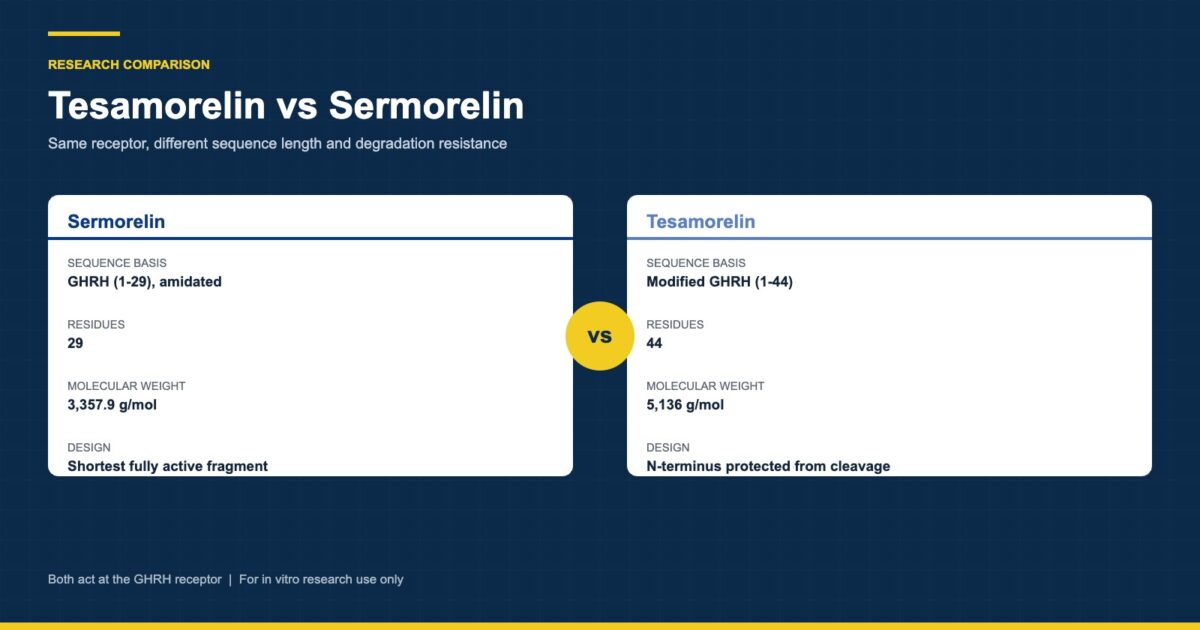
Sermorelin is GHRH(1-29) with an amide group at the C-terminus. It is the shortest fully active fragment of the native hormone, which is exactly why it became the reference GHRH analog. Nothing has been added to it and nothing has been redesigned. It is native sequence, truncated.
Tesamorelin is the complete GHRH(1-44) sequence carrying a trans-3-hexenoyl group attached to the N-terminal tyrosine. That added group is the entire point of the molecule. By occupying the N-terminus it obstructs the enzymatic cleavage that degrades native GHRH, which extends how long the analog survives intact. Its development code was TH9507, and the resulting compound carries the international nonproprietary name tesamorelin.
So one molecule is smaller than the native hormone and one is larger. Both bind the same receptor. The design question separating them is whether you want the minimum sequence that activates the receptor, or the full sequence that resists being broken down.
Molecular profiles
| Research criterion | Sermorelin | Tesamorelin |
|---|---|---|
| Class | GHRH analog | Stabilized GHRH analog |
| Receptor target | GHRH receptor | GHRH receptor |
| Sequence basis | GHRH (1-29), amidated | Modified GHRH (1-44) |
| Structural modification | None, native sequence truncated | Trans-3-hexenoyl group on the N-terminal tyrosine |
| Residues | 29 | 44 |
| Molecular formula | C149H246N44O42S | C221H366N72O67S |
| Molecular weight | 3,357.9 g/mol | 5,136 g/mol |
| CAS number | 86168-78-7 | 218949-48-5 |
| PubChem CID | 16132413 | 16137828 |
| Development code | Not applicable | TH9507 |
| Design emphasis | Shortest fully active fragment | Full sequence with degradation resistance |
| Human trial literature | Older, pediatric and diagnostic | Large, controlled, modern |
| Form supplied | Lyophilized powder | Lyophilized powder |
Tesamorelin is roughly 1.5 times the mass of Sermorelin. That matters practically: an equal mass of each is not an equal number of molecules, so any comparison prepared by weight rather than by moles is not comparing like with like.
Stability, and why it is the whole argument
Native GHRH is cleaved rapidly by dipeptidyl peptidase-4. Because Sermorelin retains the native N-terminus, it carries the same vulnerability. Tesamorelin’s hexenoyl group sits at precisely the point that enzyme attacks, which is the mechanistic reason the modified analog persists longer.
For laboratory work this is not an abstract point. In any system containing serum, plasma or tissue that carries peptidase activity, the two compounds will not remain intact for the same length of time. A protocol that samples at a single late time point may capture a Tesamorelin signal and miss a Sermorelin one entirely, purely because the second compound is no longer there. Where the compounds are being compared directly, degradation rate has to be treated as a variable in the design rather than assumed away.
This also reframes the common question of which compound is “stronger”. Sermorelin and Tesamorelin engage the same receptor, so the difference is less about how hard each pushes the receptor and more about how long each survives to keep pushing it. Duration, not raw receptor affinity, is the axis the comparison actually runs on.
IGF-1, the shared downstream readout
Growth hormone released from the pituitary acts on the growth hormone receptor in peripheral tissue, principally the liver, and one consequence is transcription of insulin-like growth factor 1. Because IGF-1 has a longer and steadier presence than the pulses of growth hormone that drive it, it is the standard downstream marker used to read growth-hormone-axis activity in preclinical work.
This is worth stating plainly because it explains the shape of most published study designs on both compounds. Measuring growth hormone directly means catching a pulse, which requires frequent sampling and is easy to miss. Measuring IGF-1 integrates the signal over a longer window. Any study comparing two GHRH analogs is very likely reading IGF-1, and knowing that makes the literature on both compounds far easier to interpret.
Development history, and why it changes what you can cite
This is the difference most comparisons skip, and it is the one that matters most to a researcher deciding which compound to build a study around.
Tesamorelin was developed as a pharmaceutical and taken through controlled human trials, most prominently a randomized study of its metabolic effects published in the New England Journal of Medicine (Falutz et al., 2007). It went on to receive a brand name, Egrifta, and an ATC classification as a pituitary hormone, H01AC06. Follow-up analyses of the trial population have since been published, including work on which characteristics predicted response (Mangili et al., 2015).
Sermorelin has a different profile. It carries two ATC classifications rather than one: H01AC04 as a pituitary hormone, and V04CD03 as a diagnostic agent. That second code is the informative one. Sermorelin’s principal established role was in assessing pituitary growth hormone reserve, using a short, fully active GHRH fragment to provoke a measurable response. Its therapeutic literature centers on pediatric growth hormone deficiency and is considerably older than Tesamorelin’s.
The practical consequence for a research programme is straightforward. A study built around Tesamorelin can be positioned against a substantial modern controlled literature. A study built around Sermorelin is working with an older evidence base concentrated on a narrower set of questions. That is not a defect in either compound, but it does change what a paper can reference, and it is a reason to choose deliberately.
Adipose tissue as a research endpoint
Tesamorelin’s clinical development concentrated on visceral adipose tissue, which is why almost every page written about this comparison leads on body fat. It is worth being precise about what that literature is and is not.
The published work measured visceral adipose tissue by imaging in a defined human patient population, alongside metabolic markers including IGF-1 and lipid parameters. It is a body of clinical research about a specific condition in a specific group of people. It is not evidence about anyone outside that population, it establishes nothing about healthy individuals, and it says nothing about what any reader of this page might experience. It is cited here for one reason: it explains why adipose tissue and metabolic markers are the endpoints preclinical GHRH-analog studies tend to measure, and it is the reason Tesamorelin has the evidence base it has.
Peptides Source supplies both compounds for in vitro and laboratory research only. Nothing in that literature translates into a use for research-grade material.
How each is used as a research tool
Sermorelin functions as the reference GHRH-pathway compound. Because it is the minimal fully active fragment, it gives a clean baseline for GHRH-receptor signaling work and a natural comparator when characterizing newer or modified analogs. If the experimental question is about the receptor itself rather than about analog design, Sermorelin is the direct tool.
Tesamorelin is the tool where stability is part of the model: comparing modified against unmodified analogs, studying how N-terminal protection alters a peptide’s persistence, or working in a system where a short-lived compound would not survive the protocol. Our Tesamorelin research profile covers its mechanism and preclinical models.
Used together they form a natural pair, because they differ in one designed respect while sharing a receptor. That makes them a cleaner comparison than most, and it is the reason the two appear together so often in the literature.
Where they sit against the rest of the toolkit
Neither compound exists in isolation. CJC-1295 is a further GHRH analog, also based on the 1-29 fragment, modified for extended duration. Ipamorelin, the GHRPs and hexarelin sit on the other arm of the axis entirely, acting at the ghrelin receptor rather than the GHRH receptor. Recombinant growth hormone itself, somatropin, bypasses the pituitary and acts directly at the growth hormone receptor.
Placing the two compounds on that map is the fastest way to understand them. Sermorelin and Tesamorelin are both upstream, both GHRH-receptor, and differ only in sequence length and stabilization. Our growth hormone axis research overview maps the full toolkit.
Verification: the part nobody else covers
Neither comparison means anything if the material in the vial is not what the label says, and this is the one area where the pages ranking for this comparison have almost nothing to say. Research-grade supply of either compound should meet the same documentation bar:
- Purity verified by HPLC, with the figure recorded on a batch-specific certificate of analysis tied to your lot number
- Identity confirmed by mass spectrometry against the expected molecular mass, which differs substantially between these two, 3,358 against 5,136, and is therefore an unusually clear check
- Third-party testing, independent of the supplier
- Documented sourcing, US-based, for traceability
The mass difference deserves emphasis. Because the two compounds are separated by roughly 1,800 daltons, a mass spectrometry result distinguishes them immediately and unambiguously. There is no plausible way to confuse one for the other on a correctly reported certificate, which makes the certificate genuinely worth reading rather than a formality.
Handling and storage
Both are supplied as lyophilized powders and reconstituted in the laboratory before study. The lyophilized form is the stable one. Sealed vials are kept frozen and protected from light; reconstituted material is refrigerated, aliquoted so that repeated freeze-thaw cycles are avoided, and used within a short window.
Tesamorelin’s added stability applies to enzymatic degradation in a biological system. It does not make the lyophilized powder more tolerant of poor storage, and it is not a reason to relax handling. Reconstitution volumes, storage duration and study design are matters for the individual research protocol and the institution’s own standard operating procedures.
Choosing between them for a study
The choice is a research-design question, not a ranking.
Choose Sermorelin when the question is about GHRH-receptor signaling itself and you want the minimal fully active sequence as a clean baseline, when you are characterizing a new analog and need the reference point it is designed against, or when the assay is short enough that degradation rate is not a confounder.
Choose Tesamorelin when analog stability is itself the variable, when the system contains peptidase activity that would degrade an unprotected analog before the readout, or when you want the compound with the larger and more recent controlled literature behind it.
Use both when the object of study is the effect of N-terminal modification, since they differ in that one designed respect while sharing a receptor.
Whichever is chosen, confirm batch-specific HPLC purity and mass spectrometry identity before use, so that results are attributable to the experiment rather than to the material.
Frequently asked questions
What is the difference between Tesamorelin and Sermorelin?
Both are synthetic GHRH-receptor agonists, so they act at the same receptor. Sermorelin is GHRH(1-29), the shortest fragment of the native hormone that retains full activity. Tesamorelin is the complete GHRH(1-44) sequence with a trans-3-hexenoyl group on the N-terminal tyrosine, added to obstruct the enzymatic cleavage that degrades native GHRH. The difference is length and degradation resistance, not receptor target.
Which is more stable, Tesamorelin or Sermorelin?
Tesamorelin. Native GHRH is cleaved by dipeptidyl peptidase-4 near the N-terminus, and Sermorelin retains that native N-terminus and therefore that vulnerability. Tesamorelin’s hexenoyl group sits at the point of attack, which is the mechanistic basis for its longer persistence in systems containing peptidase activity.
Do Tesamorelin and Sermorelin act on the same receptor?
Yes. Both are GHRH-receptor agonists. This distinguishes the pairing from comparisons such as Ipamorelin against Sermorelin, where the two compounds act at genuinely different receptors, the ghrelin receptor and the GHRH receptor respectively.
Which has more research behind it?
Tesamorelin, by a clear margin in modern controlled human research, including a randomized trial published in the New England Journal of Medicine in 2007 and subsequent analyses. Sermorelin’s record is older and concentrated on pediatric growth hormone deficiency and on diagnostic assessment of pituitary growth hormone reserve, reflected in its dual classification as both a pituitary hormone and a diagnostic agent.
How does Tesamorelin compare to CJC-1295?
Both are modified GHRH analogs designed for greater persistence than the native sequence, but they take different routes. CJC-1295 is built on the 1-29 fragment, the same basis as Sermorelin, with modifications for extended duration. Tesamorelin retains the full 1-44 sequence and protects the N-terminus. They are alternative solutions to the same degradation problem.
Is IGF-1 relevant to comparing these two compounds?
Yes, and it is how most of the literature reads them. Growth hormone drives IGF-1 transcription downstream, and because IGF-1 is steadier than the pulses of growth hormone that produce it, it is the standard integrated readout of axis activity in preclinical work. Studies comparing GHRH analogs are typically measuring IGF-1 rather than attempting to catch individual growth hormone pulses.
What purity should research-grade Tesamorelin and Sermorelin meet?
Both should be verified by HPLC at 98 percent or higher on a batch-specific certificate of analysis, with identity confirmed by mass spectrometry and testing performed by an independent third-party laboratory. The roughly 1,800 dalton mass difference between the two makes the identity check unusually decisive.
How are Tesamorelin and Sermorelin stored and handled?
Both are supplied as lyophilized powders and reconstituted in the laboratory before study. Sealed lyophilized vials are stored frozen and protected from light; reconstituted material is kept refrigerated, aliquoted to avoid repeated freeze-thaw cycles, and used within a short window. Tesamorelin’s stability advantage applies to enzymatic degradation, not to storage, so handling standards are the same for both.
References
- US National Library of Medicine, PubChem. Compound record: Sermorelin, CID 16132413.
- US National Library of Medicine, PubChem. Compound record: Tesamorelin, CID 16137828.
- Falutz J, Allas S, Blot K, et al. Metabolic effects of a growth hormone-releasing factor in patients with HIV. N Engl J Med. 2007;357(23):2359-2370. PMID 18057338.
- Mangili A, Falutz J, Mamputu JC, et al. Predictors of treatment response to tesamorelin, a growth hormone-releasing factor analog, in HIV-infected patients with excess abdominal fat. PLoS One. 2015;10(10):e0140358. PMID 26457580.
- Brooks AJ, Wooh JW, Tunny KA, Waters MJ. Growth hormone receptor; mechanism of action. Int J Biochem Cell Biol. 2008;40(10):1984-1989. PMID 17888716.
Peptides Source supplies research compounds for in vitro and laboratory research only. Nothing on this page is a recommendation for human or veterinary use. All products are sold strictly for research purposes and are not for human or animal consumption. The full research range is in our musculoskeletal and growth research category.