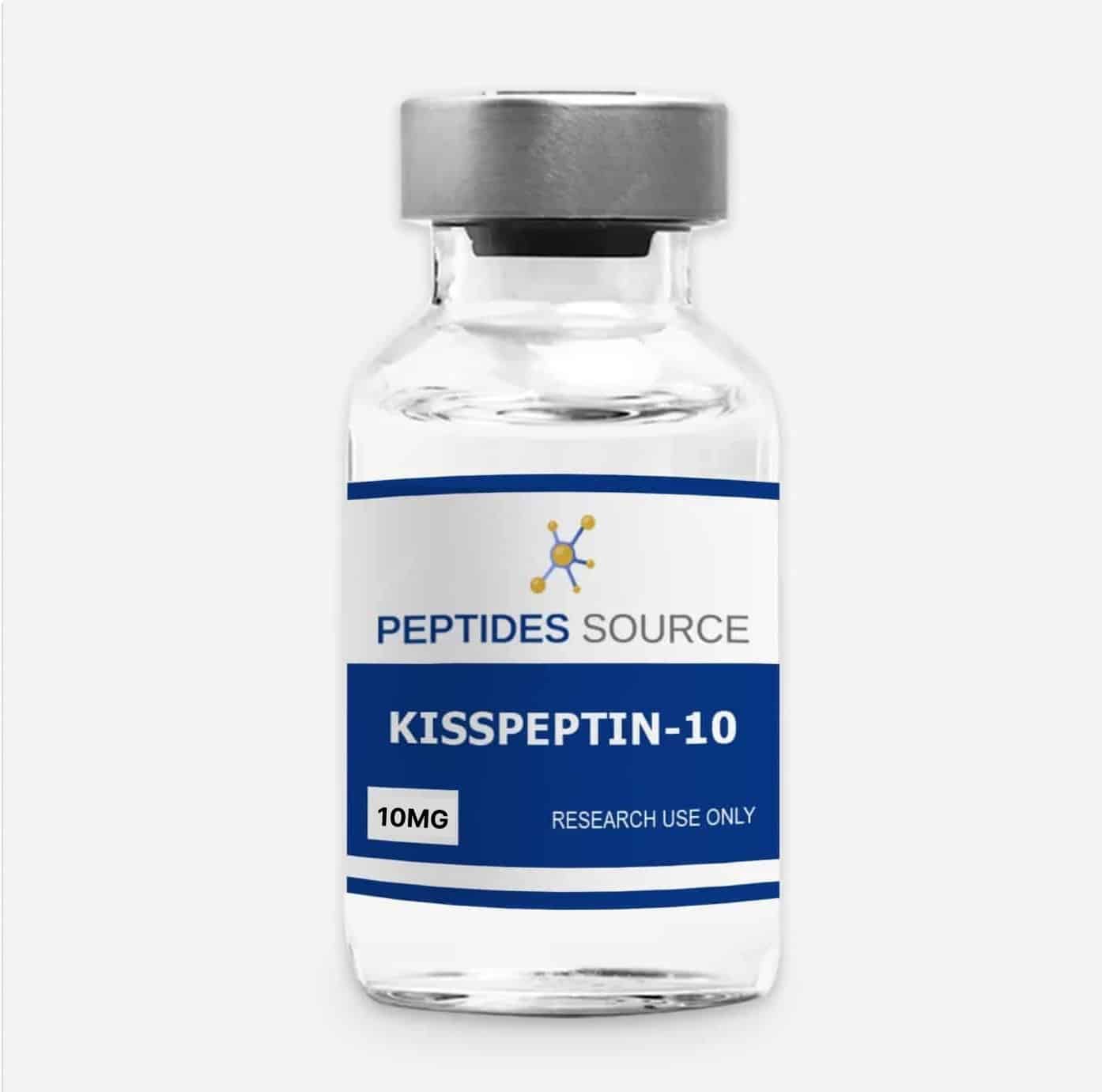
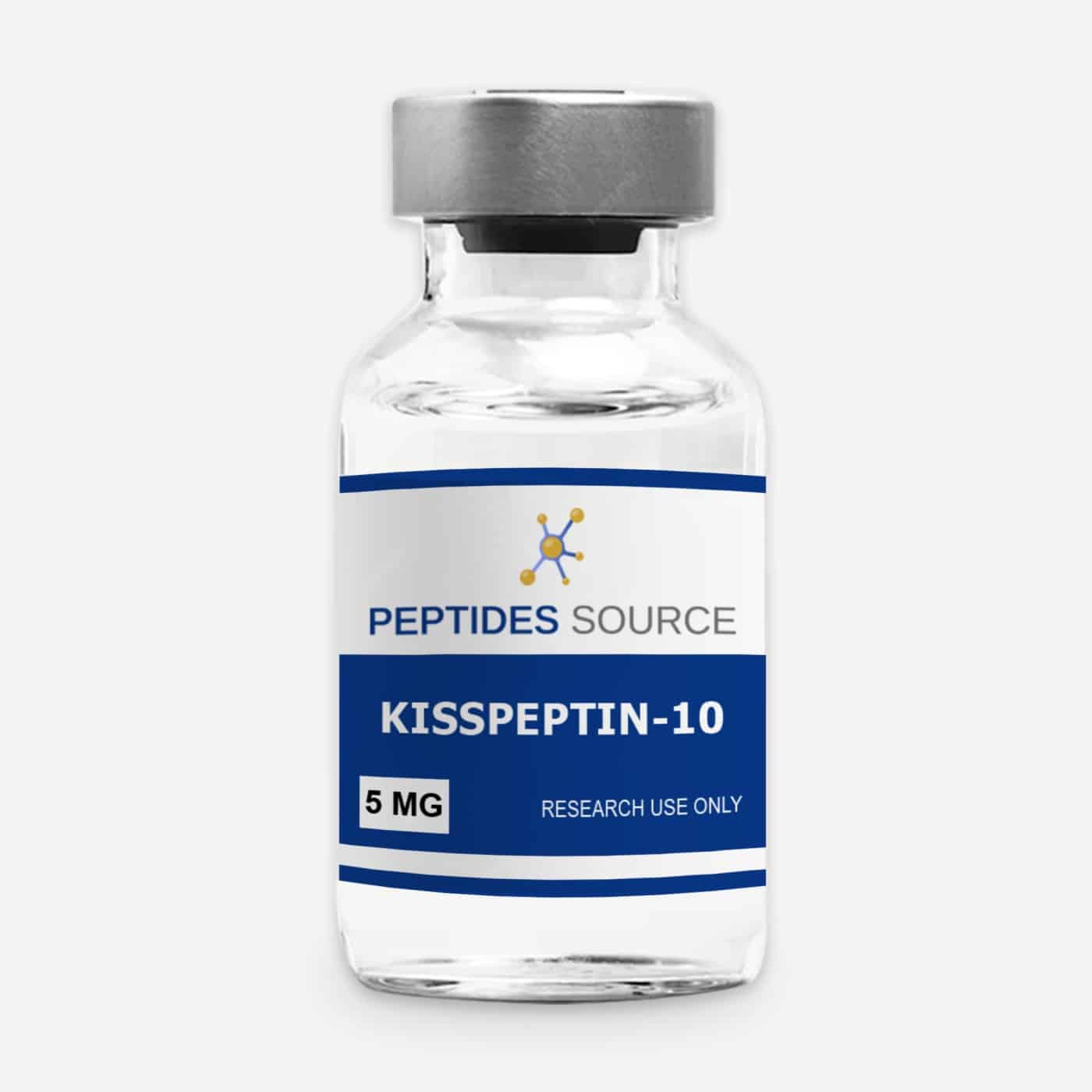

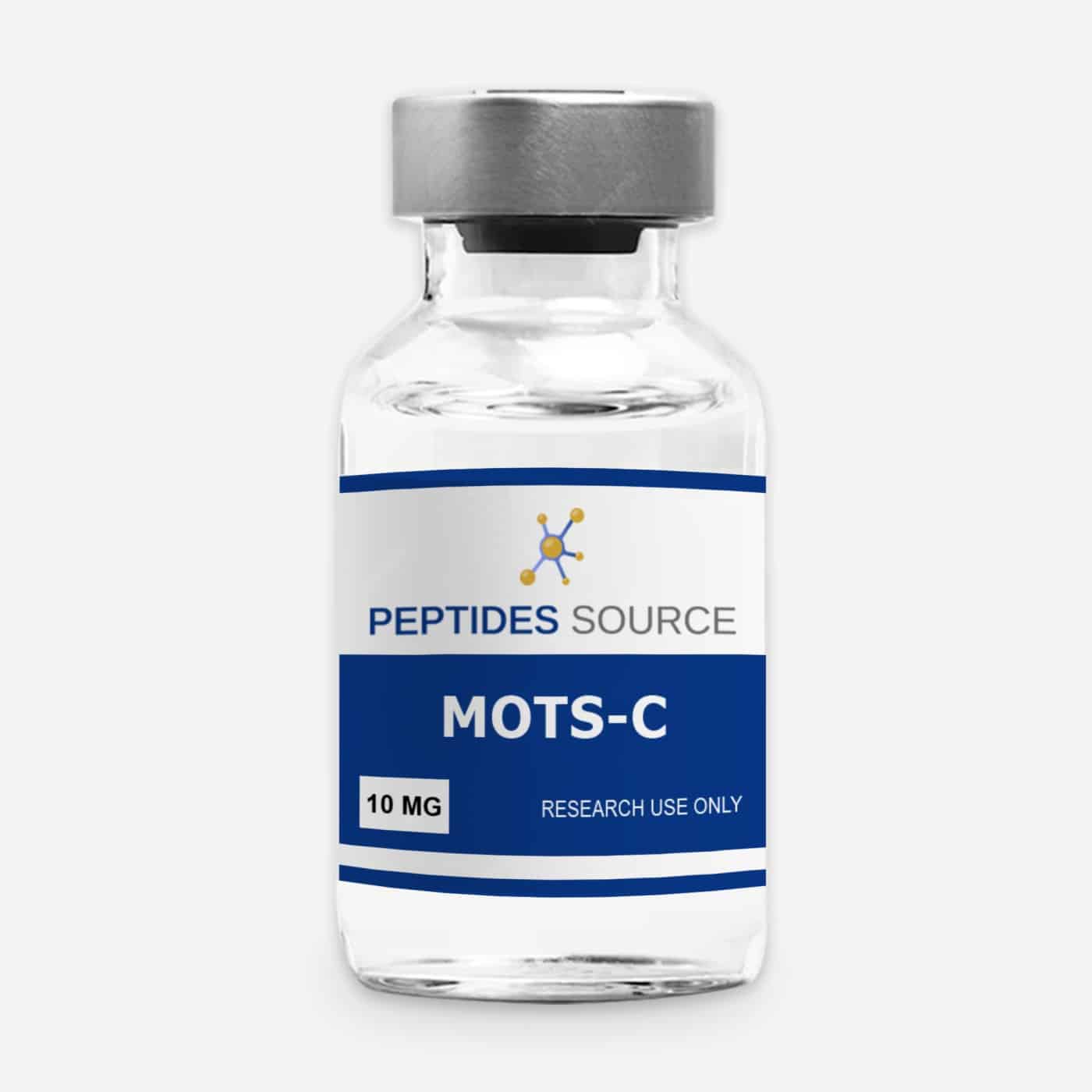


Most pages about this compound describe what it is associated with rather than what it is. This one does the opposite. It sets out what kisspeptin 10 is, the fragment that name refers to: which receptor it engages, what happens downstream of that engagement, how it relates to the longer forms of the same gene product, and what a certificate of analysis should tell you before the vial goes anywhere near an assay. The compound is supplied through our kisspeptin research vials, with the fragment stated on the batch certificate rather than on the product name. It is written for qualified researchers working with in vitro and controlled animal-model systems, and it describes molecular and research characteristics only, not outcomes in people. The 5mg research vial is supplied on the same terms.
All compounds discussed are intended strictly for in vitro research and laboratory use. Not for human or animal consumption. This page describes receptor pharmacology and laboratory characteristics only. It makes no physiological, therapeutic or outcome claims of any kind.
The short version
- Kisspeptin-10 is a decapeptide, the C-terminal ten residues of a much larger precursor, and it carries the complete receptor-activating region shared by every form.
- Its receptor is KISS1R, still widely called GPR54 in the older literature. The two names refer to the same receptor.
- All the kisspeptins share one active C-terminus. Kisspeptin-54, -14, -13 and -10 are different lengths of the same gene product and they converge on the same receptor.
- The receptor signals through Gq/11, not Gs, so the standard laboratory readout is inositol phosphate accumulation or intracellular calcium, not cAMP.
- For research use only. Not for human or veterinary use or consumption.
Structure: why the last ten residues are the ones that matter
The KISS1 gene encodes a 138-residue precursor protein (UniProt Q15726). That precursor is cleaved into several peptides of different lengths, and the naming convention follows the length of each fragment: kisspeptin-54, kisspeptin-14, kisspeptin-13 and kisspeptin-10.
The important structural fact is that all of them terminate in the same ten residues. The human kisspeptin-10 sequence is Tyr-Asn-Trp-Asn-Ser-Phe-Gly-Leu-Arg-Phe-NH2, and that sequence sits at the C-terminus of every longer form. Everything N-terminal to it is, from the receptor’s point of view, extension rather than pharmacophore.
Two features of that decapeptide are worth naming. The C-terminus is amidated rather than left as a free acid, and the terminal Arg-Phe-NH2 motif is what places kisspeptin in the RFamide peptide family. Both are functional rather than incidental: the amide is part of what the receptor recognizes.
The practical consequence for a laboratory is direct. Kisspeptin-10 carries the complete pharmacophore and is the shortest fully active fragment in common use, which makes it the cheapest to synthesize, the easiest to characterize analytically, and the least ambiguous to work with. That is why it dominates the research literature rather than the full-length form. Relative potency between the fragments is assay and species dependent, so a comparison across forms should be made within one system rather than read across papers.
Kisspeptin 10: molecular profile
| Research criterion | Value |
|---|---|
| Class | RFamide decapeptide, KISS1 gene product |
| Also known as | Kisspeptin-10, metastin (45-54), KP-10 |
| Sequence | Tyr-Asn-Trp-Asn-Ser-Phe-Gly-Leu-Arg-Phe-NH2 |
| C-terminus | Amidated |
| Molecular formula | C63H83N17O14 |
| Molecular weight | 1,302.4 g/mol |
| CAS number | 374675-21-5 |
| PubChem CID | 25240297 |
| Receptor target | KISS1R, also designated GPR54 |
| Receptor class | Class A G-protein-coupled receptor, Gq/11 coupled |
| Parent gene | KISS1, 138-residue precursor, UniProt Q15726 |
| Position in precursor | Residues 112 to 121 |
| Form supplied | Lyophilized powder |
At roughly 1,302 g/mol this is a small peptide, well inside the range where a routine mass spectrometry run gives an unambiguous identity check against the expected mass.
The receptor, and the two names it goes by
Kisspeptin-10 acts at KISS1R, a class A G-protein-coupled receptor. A great deal of the literature, particularly anything published before roughly 2010, calls the same receptor GPR54, from the period when it was an orphan receptor without a known ligand.
This matters when reading a certificate, a catalog entry or a paper: KISS1R and GPR54 are not two receptors, they are one receptor with two names. A protocol that handles them as separate targets has made a bookkeeping error, not a pharmacological distinction.
The receptor was deorphanized when kisspeptin was identified as its endogenous ligand. The separate name metastin belongs to the ligand rather than the receptor, and comes from an earlier research context entirely, and it still appears in the database records for the KISS1 gene product under accession Q15726. So there are two names for one receptor, and a second name for the peptide that activates it.
Downstream signaling: what is actually measured
This is the detail most often got wrong, and it changes assay design.
KISS1R couples principally to Gq/11, not to Gs. Agonist binding activates phospholipase C, which hydrolyzes PIP2 into inositol trisphosphate and diacylglycerol, and the inositol trisphosphate in turn drives release of calcium from intracellular stores.
So the standard functional readouts in a kisspeptin assay are inositol phosphate accumulation and intracellular calcium mobilization. A cAMP assay, which is the default readout for a Gs-coupled receptor such as the melanocortin family, is the wrong measurement here and will not report what the experimenter thinks it reports.
The practical rule: match the readout to the coupling. If a protocol has been adapted from a Gs-coupled receptor system, the second messenger it measures needs changing before it is pointed at KISS1R.
Where it sits in the neuroendocrine cascade
The reason kisspeptin appears so heavily in neuroendocrine research is positional. KISS1R is expressed on gonadotropin-releasing hormone neurons, which places kisspeptin signaling upstream of GnRH rather than alongside it.
That position is what makes it useful as a tool compound. A probe that acts upstream of a cascade lets a researcher ask what switches the cascade on, rather than only what happens once it is running. Kisspeptin-expressing neuron populations in the hypothalamus are studied as integration points where metabolic, circadian and steroid-feedback inputs converge before being relayed onward. The receptor biology behind that work, in cell systems and animal models, is reviewed in Colledge, 2008.
None of that is a statement about effects in people. It describes where a receptor sits in a signaling hierarchy that has been mapped in cell systems and animal models.
Choosing a form for a study
Because the forms share a pharmacophore but differ in length, the choice between them is an experimental design question rather than a potency question.
| Form | Length | Research note |
|---|---|---|
| Kisspeptin-54 | 54 residues | The full-length form, also called metastin. Carries the same active C-terminus |
| Kisspeptin-14 | 14 residues | Intermediate cleavage product, same C-terminal decapeptide |
| Kisspeptin-13 | 13 residues | Intermediate cleavage product, same C-terminal decapeptide |
| Kisspeptin-10 | 10 residues | Shortest form retaining full receptor activity. The standard research fragment |
Choose kisspeptin-10 when the question concerns receptor engagement and downstream signaling, which is most of the time. Choose a longer form when the length itself is the variable, for example when studying processing, clearance or the behavior of the extended N-terminal region. Species differences in sequence exist across the longer forms, so a study crossing species should confirm which sequence a supplier is actually shipping rather than assuming the human one.
How it is used as a research tool
- Functional assays in cells expressing recombinant KISS1R, measuring inositol phosphate or calcium responses to establish potency.
- Binding studies characterizing affinity at KISS1R and confirming selectivity against other RFamide receptors.
- Comparative fragment studies across kisspeptin-54, -14, -13 and -10, to separate the contribution of the pharmacophore from that of the extended sequence.
- Rodent neuroendocrine models, where kisspeptin is used to probe the hierarchy above GnRH signaling.
Its provenance is documented the same way as the rest of our US-made research catalog.
Verification: what a certificate should tell you
Reproducibility depends on knowing exactly what is in the vial, and on this compound there is one check beyond the usual set.
- Purity verified by HPLC, with the figure recorded on a batch-specific certificate of analysis tied to your lot number
- Identity confirmed by mass spectrometry against the expected mass of 1,302.4 g/mol
- Which form, stated explicitly. Confirm the fragment on the certificate for your own lot rather than inferring it from a product name. The kisspeptins differ in mass by hundreds of daltons between the shorter fragments and by thousands between kisspeptin-10 and kisspeptin-54. A certificate that says only “kisspeptin” without naming the fragment is ambiguous, and the mass is what resolves it
- Amidation confirmed. A free-acid C-terminus is a different species from the amidated peptide and differs in mass by roughly one dalton
- Third-party testing, independent of the supplier
- Documented sourcing, US-based, for traceability
Peptides Source supplies its kisspeptin research material at 98 percent or higher purity by HPLC with third-party batch documentation, and the batch certificate is what states which fragment a given lot contains. For the criteria to apply to any supplier, see our guide to choosing a reliable peptide source.
Handling in the laboratory
Supplied as a lyophilized powder and reconstituted before study.
- Reconstitution: use a diluent appropriate to the assay, commonly bacteriostatic water. Confirm solubility in the intended vehicle before preparing working solutions.
- Storage, lyophilized: sealed vial frozen at approximately -20 degrees Celsius, protected from light.
- Storage, reconstituted: refrigerated at 2 to 8 degrees Celsius, aliquoted to avoid repeated freeze-thaw cycles, used within a short window.
Unlike a cyclized or D-amino-acid-substituted analog, kisspeptin-10 is a linear all-L peptide, so it carries no particular protease resistance. Where an assay runs over an extended period, that is a variable worth controlling rather than assuming away.
Frequently asked questions
What is kisspeptin 10?
Kisspeptin-10 is a decapeptide with the sequence Tyr-Asn-Trp-Asn-Ser-Phe-Gly-Leu-Arg-Phe-NH2, corresponding to the C-terminal ten residues of the KISS1 gene product. It carries the complete pharmacophore and is the shortest fully active fragment in common use at the receptor KISS1R, which makes it the standard research fragment. It is supplied strictly for in vitro and laboratory research.
What receptor does kisspeptin 10 act on?
KISS1R, a class A G-protein-coupled receptor that is also called GPR54 in the older literature. The two names refer to the same receptor, which was designated GPR54 while it was still an orphan receptor and renamed once kisspeptin was identified as its endogenous ligand.
What is the difference between kisspeptin-10 and kisspeptin-54?
Length, and nothing else that the receptor sees. Both are products of the KISS1 gene and both terminate in the same active decapeptide. Kisspeptin-54 is the full-length form, sometimes called metastin; kisspeptin-10 is just that shared C-terminal region. Kisspeptin-10 is more common in research because it retains full receptor activity in a shorter, more tractable sequence.
Which second messenger should a kisspeptin assay measure?
Inositol phosphate accumulation or intracellular calcium. KISS1R couples principally to Gq/11 and signals through phospholipase C, so a cAMP readout, which suits a Gs-coupled receptor, is the wrong measurement. A protocol adapted from a Gs-coupled system needs its readout changed before it is pointed at this receptor.
Why is the amidated C-terminus important?
The terminal Arg-Phe-NH2 motif is what places kisspeptin in the RFamide peptide family and it is part of what the receptor recognizes. A free-acid C-terminus is a different chemical species, differing in mass by roughly one dalton, so amidation is worth confirming on the certificate rather than assuming.
What purity should research-grade kisspeptin 10 meet?
Verified by HPLC at 98 percent or higher on a batch-specific certificate of analysis, with identity confirmed by mass spectrometry against the expected 1,302.4 g/mol. The certificate should also state which kisspeptin form it describes, because a bare compound name is ambiguous and the fragments are separated by hundreds to thousands of daltons depending on the pair.
Is kisspeptin-10 the same as metastin?
They are closely related but not identical terms. Metastin generally refers to the full-length 54-residue form, and kisspeptin-10 is described in databases as metastin (45-54), meaning residues 45 to 54 counted from the start of metastin. Counted from the start of the KISS1 precursor instead, the same fragment is residues 112 to 121. Both numberings are correct and they describe the same ten residues.
How is kisspeptin 10 stored and handled?
Supplied as a lyophilized powder and reconstituted in the laboratory, typically in bacteriostatic water. Sealed lyophilized vials are stored frozen at approximately -20 degrees Celsius and protected from light. Reconstituted material is refrigerated at 2 to 8 degrees Celsius, aliquoted to avoid repeated freeze-thaw cycles, and used within a short window. It is a linear all-L peptide with no particular protease resistance, so assay duration is a variable worth controlling.
References
- US National Library of Medicine, PubChem. Compound record: Kisspeptin-10 (human), CID 25240297.
- Colledge WH. GPR54 and kisspeptins. Results Probl Cell Differ. 2008;46:117-143. PMID 18193176.
- UniProt Consortium. Protein record for the KISS1 gene product, accession Q15726.
Peptides Source supplies research compounds for in vitro and laboratory research only. Nothing on this page is a recommendation for human or veterinary use. All products are sold strictly for research purposes and are not for human or animal consumption. Must be 21+ to purchase.