

All compounds discussed are intended strictly for in vitro research and laboratory use. Not for human or animal consumption.
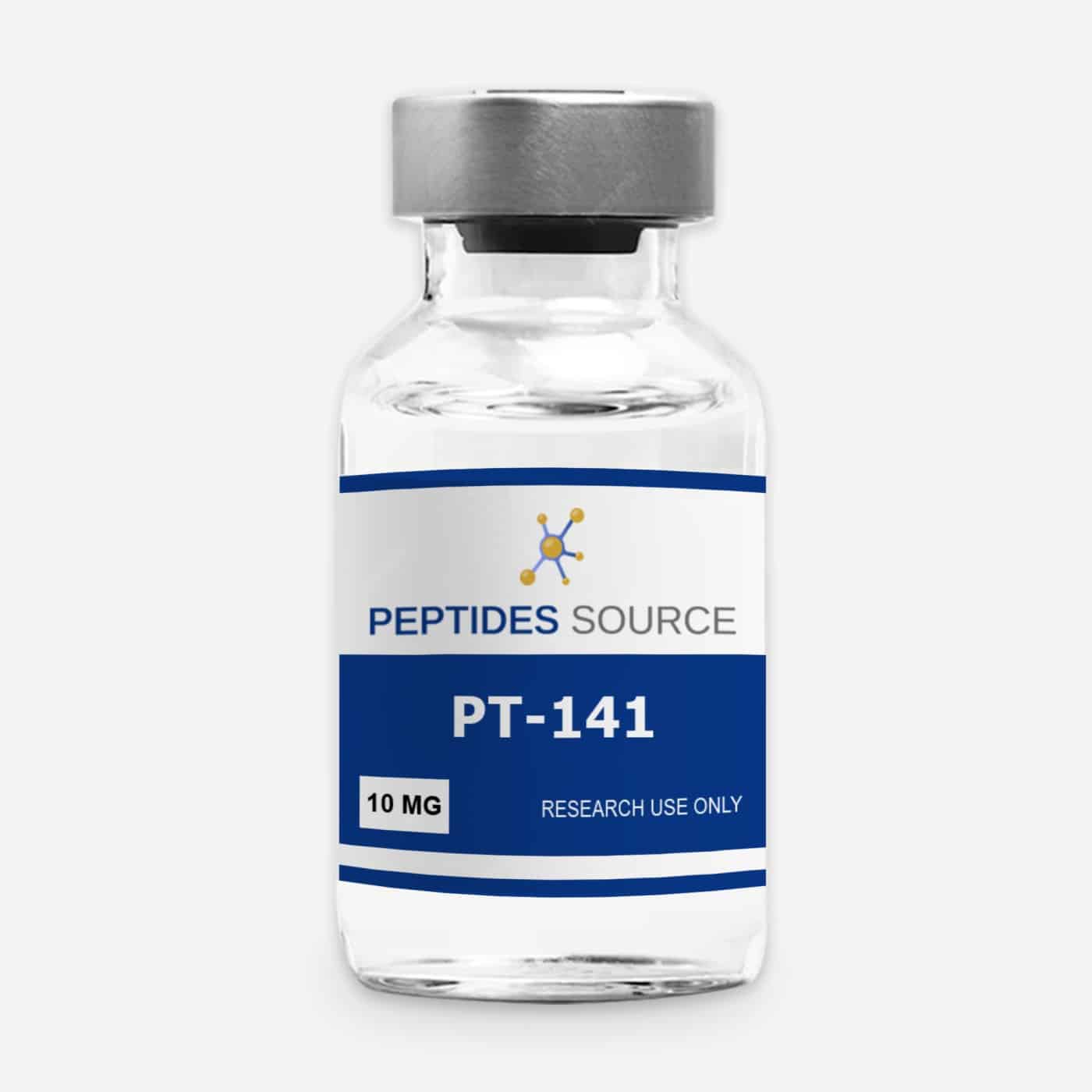
Most of what is written about PT-141 describes what it is associated with rather than how it works. This page does the opposite. It sets out the molecular structure of bremelanotide, which melanocortin receptor subtypes it engages, what happens downstream of that engagement, and why those properties make it a useful tool compound in receptor pharmacology. It is written for qualified researchers working in in vitro and controlled animal-model systems, and it describes molecular and research characteristics only, not outcomes in people.
The short version
- PT-141 is a cyclic heptapeptide, not a linear one. A lactam bridge between residues 2 and 7 locks the backbone into a constrained ring.
- It is a melanocortin receptor agonist, with activity at MC3R and MC4R and weaker activity at MC1R.
- Its parent compound is melanotan II, itself an analog of alpha-melanocyte-stimulating hormone. PT-141 is the C-terminal deamidated metabolite of that molecule.
- The melanocortin receptors are class A GPCRs that signal principally through Gs and adenylyl cyclase, so the standard laboratory readout is cAMP accumulation.
- For research use only. Not for human or veterinary use or consumption.
Structure: why the ring matters
PT-141’s identity as a cyclic peptide is the single most important thing about it structurally, and it is the detail most pages omit.
The sequence is Ac-Nle-Asp-His-D-Phe-Arg-Trp-Lys, closed by a (2 to 7) lactam bridge between the side chains of the aspartate at position 2 and the lysine at position 7. Two further features are worth noting. The N-terminus is acetylated. And the phenylalanine at position 4 is the D-isomer rather than the L-form found in natural proteins.
Each of those three choices does something. The lactam bridge removes most of the conformational freedom a linear heptapeptide would have, which means the molecule presents a much more defined shape to the receptor. The D-amino acid and the acetylated N-terminus both make the peptide a poorer substrate for proteases. A constrained, protease-resistant ring is a deliberately engineered molecule, not a fragment of something natural.
The core His-Phe-Arg-Trp motif running through positions 3 to 6 is the conserved melanocortin pharmacophore, the same sequence that appears in alpha-melanocyte-stimulating hormone. That shared motif is why the compound engages melanocortin receptors at all, and the cyclic scaffold around it is what tunes the selectivity.
Molecular profile
| Research criterion | Value |
|---|---|
| Class | Synthetic cyclic heptapeptide, melanocortin receptor agonist |
| Also known as | Bremelanotide |
| Sequence | Ac-Nle-Asp-His-D-Phe-Arg-Trp-Lys |
| Cyclization | (2 to 7) lactam bridge |
| Molecular formula | C50H68N14O10 |
| Molecular weight | 1,025.2 g/mol |
| CAS number | 189691-06-3 |
| PubChem CID | 9941379 |
| UNII | 6Y24O4F92S |
| Receptor targets | MC3R and MC4R agonist, weaker MC1R activity |
| Parent compound | Melanotan II |
| Originator | Palatin Technologies |
| Form supplied | Lyophilized powder |
At roughly 1,025 g/mol this is a small molecule by peptide standards, which is consistent with a seven-residue ring and is convenient analytically: the mass is well within the range where a routine mass spectrometry run gives an unambiguous identity check.
The melanocortin receptor family
There are five melanocortin receptors, MC1R through MC5R. All five are class A G-protein-coupled receptors, all five couple principally to Gs, and all five therefore raise intracellular cAMP when activated. What separates them is where they are expressed and which endogenous ligands they prefer.
This matters for a tool compound because selectivity is the whole question. A ligand that hits all five subtypes equally tells a researcher very little. A ligand with a defined preference profile can be used to attribute an observed signal to a particular receptor.
PT-141 is an agonist at MC3R and MC4R, with weaker activity at MC1R. That profile is what makes it useful: MC3R and MC4R are the two subtypes most studied in central nervous system and energy-homeostasis research, while MC1R is the pigmentation-associated subtype. A compound that engages the former pair more readily than the latter is a reasonable probe for the central arm of melanocortin signaling.
The broader ligand landscape for these receptors, natural and synthetic, is reviewed in Yuan and Tao, 2022.
Downstream signaling: what is actually measured
Because melanocortin receptors couple to Gs, agonist binding activates adenylyl cyclase and raises cAMP. cAMP accumulation is therefore the standard functional readout in a melanocortin assay, and it is what most published potency figures for these compounds describe.
There is a subtlety worth knowing. Work on MC4R has shown that natural and synthetic agonists do not all produce the same cAMP signal over time, even when they produce comparable peak responses (Molden et al., 2015). Some ligands drive a sustained signal from internalized receptors while others produce a transient one. That temporal dimension is invisible to a single end-point measurement.
The practical consequence for study design is direct: a single-time-point cAMP reading can rank two agonists differently from a kinetic one. If a protocol is comparing melanocortin ligands, when the measurement is taken is a variable, not a detail.
Why PT-141 exists: the melanotan II relationship
PT-141 did not come out of nowhere. It is the C-terminal deamidated metabolite of melanotan II, which is itself a synthetic cyclic analog of alpha-melanocyte-stimulating hormone. In other words the lineage runs from the natural hormone, to a cyclic synthetic analog of it, to the metabolite of that analog.
This relationship explains several things at once. It explains why PT-141 retains melanocortin receptor activity, because it retains the His-Phe-Arg-Trp pharmacophore. It explains the structural similarity between the two compounds. And it explains the difference in their receptor profiles, since the C-terminal change that distinguishes them sits adjacent to the residues that contact the receptor.
For comparative receptor work, the pair is genuinely useful: two closely related cyclic melanocortin agonists differing at one defined position is a cleaner comparison than most.
Regulatory status, stated plainly
Bremelanotide is an approved pharmaceutical. It received US Food and Drug Administration approval in 2019 and is marketed under the brand name Vyleesi. The compound was developed by Palatin Technologies.
That fact belongs on this page for two reasons. First, accuracy: a mechanism profile that omits the compound’s regulatory standing is incomplete. Second, and more usefully, it draws the boundary clearly. Research-grade material is a separate supply channel and is not that approved product. Peptides Source supplies PT-141 for in vitro and laboratory research only. The existence of an approved medicine containing the same molecule does not make research-grade material a substitute for it, and nothing on this page should be read as suggesting otherwise.
How it is used as a research tool
In preclinical work PT-141 functions as a melanocortin receptor agonist for characterizing the receptors themselves. The common applications:
- Binding assays measuring affinity across MC1R through MC5R, to establish a selectivity profile.
- Functional cAMP assays in cells expressing a single recombinant subtype, to separate potency from affinity.
- Comparative ligand studies against melanotan II, afamelanotide and the endogenous melanocortins, to map which structural features drive subtype preference.
- Receptor pharmacology in CNS-expressing tissue, where MC3R and MC4R are the relevant subtypes.
PT-141 sits within the broader melanocortin research category, and its provenance is documented the same way as the rest of our US-made research catalog.
Verification: what a certificate should tell you
Reproducibility in receptor pharmacology depends on knowing exactly what is in the vial. For a cyclic peptide there is one check beyond the usual ones:
- Purity verified by HPLC, with the figure recorded on a batch-specific certificate of analysis tied to your lot number
- Identity confirmed by mass spectrometry against the expected mass of 1,025.2 g/mol
- Cyclization confirmed. The lactam bridge is formed during synthesis, and an uncyclized linear impurity has a different mass from the cyclic product. A correctly reported mass therefore also confirms the ring closed
- Third-party testing, independent of the supplier
- Documented sourcing, US-based, for traceability
Peptides Source supplies PT-141 at 98 percent or higher purity by HPLC with third-party batch documentation. For the criteria to apply to any supplier, see our guide to choosing a reliable peptide source.
Handling in the laboratory
PT-141 is supplied as a lyophilized powder and reconstituted before study. For step-by-step technique see our research peptide reconstitution protocol.
- Reconstitution: use a diluent appropriate to the assay, commonly a suitable research diluent. Confirm solubility in the intended vehicle before preparing working solutions.
- Storage, lyophilized: sealed vial frozen at approximately -20 degrees Celsius, protected from light.
- Storage, reconstituted: refrigerated at 2 to 8 degrees Celsius, aliquoted to avoid repeated freeze-thaw cycles, used within a short window.
The constrained ring and the D-amino acid make this a relatively robust peptide compared with a linear all-L sequence, but that is a statement about proteolytic stability rather than about storage. Handling standards are unchanged.
Frequently asked questions
What is the mechanism of action of PT-141?
PT-141, or bremelanotide, is an agonist at melanocortin receptors, principally MC3R and MC4R, with weaker activity at MC1R. These are class A G-protein-coupled receptors that couple to Gs, so agonist binding activates adenylyl cyclase and raises intracellular cAMP. cAMP accumulation is the standard functional readout used to measure that activity in laboratory assays.
What receptor does PT-141 act on?
Principally the melanocortin-4 receptor (MC4R) and the melanocortin-3 receptor (MC3R), with weaker activity at MC1R. The melanocortin family has five subtypes, MC1R through MC5R, and a compound’s pattern of preference across them is what determines its usefulness as a research probe.
What is the structure of PT-141?
It is a cyclic heptapeptide with the sequence Ac-Nle-Asp-His-D-Phe-Arg-Trp-Lys, closed by a lactam bridge between residues 2 and 7. The N-terminus is acetylated and the phenylalanine at position 4 is the D-isomer. Its molecular formula is C50H68N14O10 and its molecular weight is 1,025.2 g/mol.
How is PT-141 related to melanotan II?
PT-141 is the C-terminal deamidated metabolite of melanotan II, which is itself a synthetic cyclic analog of alpha-melanocyte-stimulating hormone. Both retain the conserved His-Phe-Arg-Trp melanocortin pharmacophore, which is why both engage melanocortin receptors, and the difference between them is what accounts for their differing receptor profiles.
Is PT-141 an approved drug?
Bremelanotide received US FDA approval in 2019 and is marketed under the brand name Vyleesi, developed by Palatin Technologies. Research-grade material is a separate supply channel and is not that approved product. It is supplied strictly for in vitro and laboratory research and is not approved for human or veterinary use.
Why does it matter that PT-141 is cyclic?
The lactam bridge between residues 2 and 7 restricts the backbone’s conformational freedom, so the molecule presents a defined shape to the receptor rather than sampling many. Together with the acetylated N-terminus and the D-phenylalanine, the ring also makes the peptide a poorer substrate for proteases than an equivalent linear sequence.
What purity should research-grade PT-141 meet?
It should be verified by HPLC at 98 percent or higher on a batch-specific certificate of analysis, with identity confirmed by mass spectrometry against the expected 1,025.2 g/mol. For a cyclic peptide the mass check does double duty, because an uncyclized linear impurity has a different mass from the closed ring.
How is PT-141 stored and handled?
It is supplied as a lyophilized powder and reconstituted in the laboratory, typically in a suitable research diluent. Sealed lyophilized vials are stored frozen at approximately -20 degrees Celsius and protected from light. Reconstituted material is refrigerated at 2 to 8 degrees Celsius, aliquoted to avoid repeated freeze-thaw cycles, and used within a short window.
References
- US National Library of Medicine, PubChem. Compound record: Bremelanotide, CID 9941379.
- Yuan XC, Tao YX. Ligands for melanocortin receptors: beyond melanocyte-stimulating hormones and adrenocorticotropin. Biomolecules. 2022;12(10):1407. PMID 36291616.
- Molden BM, Cooney KA, West K, et al. Temporal cAMP signaling selectivity by natural and synthetic MC4R agonists. Mol Endocrinol. 2015;29(11):1619-1633. PMID 26418335.
Peptides Source supplies research compounds for in vitro and laboratory research only. Nothing on this page is a recommendation for human or veterinary use. All products are sold strictly for research purposes and are not for human or animal consumption. Must be 21+ to purchase.