

DISCLAIMER
FOR RESEARCH USE ONLY The content in this article is for educational and informational purposes only, based on published scientific literature. The compounds discussed are not FDA-approved for human or veterinary use and are strictly intended for in-vitro laboratory research by qualified professionals. Peptides Source does not endorse or support the use of these compounds outside of a controlled research environment. Nothing in this article constitutes medical advice.
Among the growth hormone-releasing peptides (GHRPs) studied in preclinical research, Ipamorelin holds a distinctive place in the scientific literature – one defined primarily by its receptor selectivity profile. Developed by researchers at Novo Nordisk and first formally characterized in a 1998 landmark study published in the European Journal of Endocrinology, Ipamorelin was identified as the first GHRP-receptor agonist to demonstrate GH release selectivity comparable to that of endogenous GHRH itself – stimulating robust GH secretion through the GHS-R1a (ghrelin) receptor pathway without the concurrent elevation of cortisol, ACTH, or prolactin observed with earlier GH secretagogues.
This selectivity has made Ipamorelin one of the most scientifically useful research tools in the GH secretagogue class. For laboratory investigators studying GH axis signaling, GH pulse dynamics, downstream IGF-1 pathway modulation, and the effects of GHS-R1a activation on tissue-level endpoints, Ipamorelin’s clean pharmacological profile enables experimental designs that isolate ghrelin receptor pathway activity without the confounding hormonal variables introduced by less selective compounds such as GHRP-2, GHRP-6, and Hexarelin.
This article provides a comprehensive research overview of Ipamorelin – covering its molecular profile, mechanism of receptor action and signal transduction, the selectivity data that defines its research value, key findings across multiple preclinical research domains, and considerations for laboratory sourcing and handling. All content is presented strictly within an educational and research context. Ipamorelin is not approved by the FDA for any therapeutic indication and is classified for research use only.
Key Takeaways
- Ipamorelin is a synthetic pentapeptide (Aib-His-D-2-Nal-D-Phe-Lys-NH₂) that acts as a selective agonist at the GHS-R1a (ghrelin) receptor, stimulating pituitary GH release through a Gq/phospholipase C/calcium signaling cascade distinct from the cAMP pathway activated by GHRH analogs.
- The 1998 landmark characterization study by Raun and colleagues at Novo Nordisk demonstrated that Ipamorelin produces GH release comparable in potency and efficacy to GHRP-6 in both in-vitro and in-vivo preclinical models – but without stimulating ACTH or cortisol, even at exposures well above the threshold for GH release.
- Ipamorelin’s GHS-R1a activation also suppresses somatostatin release – the endogenous GH inhibitor – creating a dual mechanism of action that simultaneously stimulates GH release and reduces its inhibitory brake, a property central to its combination research value alongside GHRH analogs.
- Beyond GH pulsatility research, Ipamorelin has been investigated in bone mineral content models, gastrointestinal motility research (including a Phase 2 clinical trial context for post-surgical ileus), and glucocorticoid-induced bone formation studies.
- Ipamorelin has no FDA approval for any therapeutic indication and remains a research-use-only compound – its documented clinical history is limited to the gastrointestinal motility program, and its broader research interest is grounded in preclinical and in-vitro investigation.
Molecular Profile
Structure and Classification
Ipamorelin is a synthetic pentapeptide – a chain of five amino acids – with the sequence:
Aib-His-D-2-Nal-D-Phe-Lys-NH₂
It carries the molecular formula C₃₈H₄₉N₉O₅ with a molecular weight of approximately 711.86 Da. Several structural features of this sequence are notable from a pharmacological standpoint. The inclusion of Aib (alpha-aminoisobutyric acid) at the N-terminus – a non-proteinogenic amino acid – and D-2-Nal (D-2-naphthylalanine) and D-Phe (D-phenylalanine) at positions 3 and 4 respectively contribute to the compound’s resistance to proteolytic degradation and its receptor selectivity profile. These modifications were the product of a systematic chemistry program at Novo Nordisk aimed at identifying GHS-R1a ligands with improved selectivity over earlier GHRP compounds.
Ipamorelin was identified within a series of compounds lacking the central Ala-Trp dipeptide of GHRP-1, a structural divergence that proved pivotal in achieving the selectivity that distinguishes it from its predecessors. Its development represents a rational, medicinal chemistry-driven approach to GHS-R1a pharmacology rather than a modification of a naturally occurring sequence.
Physical Form and Reconstitution
Ipamorelin for research use is supplied in lyophilized powder form, offering stability advantages over reconstituted solutions. It is reconstituted in the laboratory using a suitable diluent before study, with reconstituted solutions stored at 4°C and used within supplier-specified timeframes. Long-term storage of lyophilized Ipamorelin at -20°C is standard practice, with single-use aliquoting recommended to avoid repeated freeze-thaw cycles that can compromise peptide integrity.
Mechanism of Action: GHS-R1a Signaling
Receptor Binding and G-Protein Coupling
Ipamorelin exerts its biological activity through selective binding to the GHS-R1a receptor – a class A G-protein coupled receptor primarily expressed on somatotroph cells in the anterior pituitary gland and in hypothalamic regions involved in GH axis regulation. This receptor is the endogenous target of ghrelin, the 28-amino acid peptide produced primarily in the stomach that serves as one of the principal physiological regulators of GH pulsatility.
Upon binding to GHS-R1a, Ipamorelin initiates coupling to the Gq/11 G-protein subunit – a mechanism distinct from the Gs/adenylate cyclase/cAMP pathway activated by GHRH receptor binding. The Gq coupling activates phospholipase C (PLC), which cleaves phosphatidylinositol 4,5-bisphosphate (PIP₂) into two second messenger molecules: inositol trisphosphate (IP₃) and diacylglycerol (DAG). IP₃ triggers the release of calcium from intracellular stores in the endoplasmic reticulum, while DAG activates protein kinase C (PKC). The resulting elevation in intracellular calcium concentration facilitates the fusion of GH-containing secretory granules with the plasma membrane, producing the pulsatile GH release documented in preclinical GHS-R1a stimulation studies.
Somatostatin Suppression: The Dual Mechanism
A pharmacologically significant additional property of GHS-R1a activation by Ipamorelin – and GH secretagogues generally – is the concurrent suppression of somatostatin release from the periventricular nucleus of the hypothalamus. Somatostatin is the primary endogenous inhibitor of GH release, governing the off-phase of each natural GH pulse. By simultaneously stimulating GH release through GHS-R1a and suppressing somatostatin-mediated inhibition, Ipamorelin generates a compound effect on GH pulse output that exceeds simple additive receptor stimulation.
This dual mechanism is the primary scientific basis for combining Ipamorelin with GHRH analogs in research protocols. When a GHRH analog activates the GHRH receptor through the cAMP/PKA pathway, and Ipamorelin simultaneously activates GHS-R1a through the Gq/calcium pathway while suppressing somatostatin, both the accelerator and the brake of GH release are engaged simultaneously from distinct molecular entry points – an experimental condition that produces GH pulse profiles of greater amplitude than either compound studied individually.
Distinction from the GHRH Receptor Pathway
The mechanistic distinction between GHS-R1a signaling (Ipamorelin’s pathway) and GHRH receptor signaling (the pathway of Tesamorelin, Sermorelin, and CJC-1295) is fundamental to understanding Ipamorelin’s research value. These two pathways are complementary rather than redundant – they converge on GH secretion through entirely distinct molecular cascades, use different second messenger systems, and are independently regulatable. This complementarity is what makes the combination of a GHRH analog with Ipamorelin a meaningful dual-pathway research design rather than simple compound redundancy.
The Selectivity Profile: What the Raun et al. 1998 Study Established
In-Vitro Characterization
The landmark 1998 characterization study by Raun, Hansen, Johansen, and colleagues at Novo Nordisk – published in the European Journal of Endocrinology under the title “Ipamorelin, the first selective growth hormone secretagogue” – remains the foundational pharmacological reference for this compound. In primary rat pituitary cell cultures, Ipamorelin released GH with an EC₅₀ of 1.3 ± 0.4 nmol/L and an Emax of 85 ± 5% relative to GHRP-6’s 100% reference – demonstrating comparable in-vitro potency to the standard GHS-R1a reference compound. Pharmacological profiling using GHRP and GHRH receptor antagonists confirmed that Ipamorelin stimulates GH release specifically via the GHRP-like (GHS-R1a) receptor rather than through GHRH receptor cross-activation.
In-Vivo Selectivity Demonstration
The critical selectivity finding of the Raun et al. study was established in conscious swine – an in-vivo model considered more physiologically relevant than anesthetized rat preparations for characterizing the hormonal specificity of GH secretagogue activity. In these studies, Ipamorelin demonstrated GH-releasing potency and efficacy comparable to GHRP-6.
The pivotal finding, however, concerned the hormonal co-stimulation profile. Administration of both GHRP-6 and GHRP-2 resulted in elevated plasma levels of ACTH and cortisol in these animal studies. Ipamorelin, by contrast, did not elevate ACTH or cortisol to levels significantly different from those observed following endogenous GHRH stimulation – and critically, this lack of off-target hormonal activation was maintained even at exposures well above the threshold for GH release. Neither FSH, LH, prolactin, nor TSH levels were affected by any of the GH secretagogues tested, confirming the anterior pituitary specificity of GHS-R1a-mediated effects.
Why Selectivity Matters for Research Design
The selectivity data from the Raun et al. study has direct implications for research design. In studies examining GH-specific physiological effects – bone metabolism, body composition marker changes, IGF-1 downstream signaling, metabolic parameter modulation – the concurrent cortisol elevation associated with GHRP-2, GHRP-6, and Hexarelin introduces experimental confounds. Cortisol and ACTH have their own broad physiological effects that can influence the same biological endpoints under investigation, making it difficult to attribute observed outcomes specifically to GH axis stimulation rather than to glucocorticoid pathway activation.
Ipamorelin’s selectivity profile effectively removes this confound, enabling investigators to study GHS-R1a-mediated GH pathway effects with greater mechanistic specificity. This is the primary reason Ipamorelin has become the preferred GH secretagogue for combination research protocols with GHRH analogs, and the standard against which other GHRPs are compared in pharmacological selectivity discussions.
Preclinical Research Domains
GH Pulsatility and IGF-1 Axis Research
The primary domain of Ipamorelin preclinical investigation is GH axis research – examining the compound’s effects on GH pulse amplitude, frequency, and downstream IGF-1 production in animal models. Research has characterized Ipamorelin’s GH-releasing profile across rodent and swine models, examining dose-response relationships, time course of GH elevation, and the relationship between GHS-R1a activation and subsequent hepatic IGF-1 synthesis.
The preservation of physiological GH pulsatility – as opposed to the continuous GH elevation associated with exogenous GH administration – has been an important focus of this research, with investigators examining whether GHS-R1a-stimulated GH release maintains the feedback architecture of the GH axis, including IGF-1 negative feedback and somatostatin regulatory activity.
Bone Research Models
A significant additional domain of Ipamorelin preclinical investigation concerns bone biology. A 1999 study by Hansen and colleagues examined whether the GH secretagogues Ipamorelin and GHRP-6 increase bone mineral content in adult female rats. Thirteen-week-old Sprague-Dawley rats were administered Ipamorelin, GHRP-6, GH, or vehicle via osmotic minipumps for 12 weeks, with bone mineral content assessed in-vivo by dual X-ray absorptiometry (DXA) at four-week intervals.
All active treatments increased total tibial and vertebral bone mineral content compared to vehicle-treated controls, with peripheral quantitative computed tomography (pQCT) analysis revealing that the increase in cortical bone mineral content was attributable to increased cross-sectional bone area rather than changes in cortical volumetric bone mineral density. These findings were interpreted as consistent with GH-mediated periosteal bone formation – informing subsequent research interest in GHS-R1a agonism as a research tool for studying bone metabolism and GH-axis-dependent skeletal biology.
A 2001 study extended this bone biology research by examining whether Ipamorelin could counteract glucocorticoid-induced decreases in bone formation in adult rats – an experimental model of glucocorticoid-associated bone metabolism disruption. This research direction reflects a broader interest in GH secretagogues as research tools for studying the relationship between the GH axis and skeletal tissue biology under pharmacologically defined conditions.
Gastrointestinal Research and Phase 2 Clinical Context
Ipamorelin has also been investigated in gastrointestinal motility research – a research direction that resulted in a Phase 2 clinical trial program examining the compound’s potential for post-surgical ileus, a condition characterized by impaired gastrointestinal motility following abdominal surgery. The scientific basis for this research direction lies in the known distribution of GHS-R1a receptors in the gastrointestinal tract and the established role of ghrelin in regulating gastric motility and enteric nervous system function.
The Phase 2 gastrointestinal clinical program – while representing the furthest clinical development of Ipamorelin in a specific therapeutic context – did not result in regulatory approval, and the compound did not progress to Phase 3 trials for this indication. This clinical context is relevant as a research reference point, confirming that GHS-R1a-mediated gastrointestinal effects constitute a biologically validated research domain for Ipamorelin, but it does not establish efficacy or safety for this or any other application in a clinically actionable sense.
Combination Research: Ipamorelin with GHRH Analogs
The Dual-Pathway Research Rationale
As established in both the Growth Hormone Axis Research hub and the Tesamorelin Research Overview, the combination of Ipamorelin with a GHRH analog represents the most scientifically substantiated multi-compound GH axis research protocol in the current peptide literature. The mechanistic rationale – simultaneous activation of GHRH receptor cAMP signaling and GHS-R1a calcium signaling, with concurrent somatostatin suppression from the GHS component – provides a clear basis for investigating whether dual-pathway activation produces GH pulse profiles qualitatively or quantitatively distinct from single-pathway stimulation.
Ipamorelin’s Role in Combination Protocols
Within these combination research designs, Ipamorelin’s role is specifically to contribute GHS-R1a pathway activation and somatostatin suppression while minimizing the confounding hormonal variables that would compromise the mechanistic interpretation of GH-specific research endpoints. Its selectivity profile makes it the preferred GHS partner in studies where clean GH axis stimulation – without cortisol, ACTH, or prolactin co-elevation – is a research design requirement.
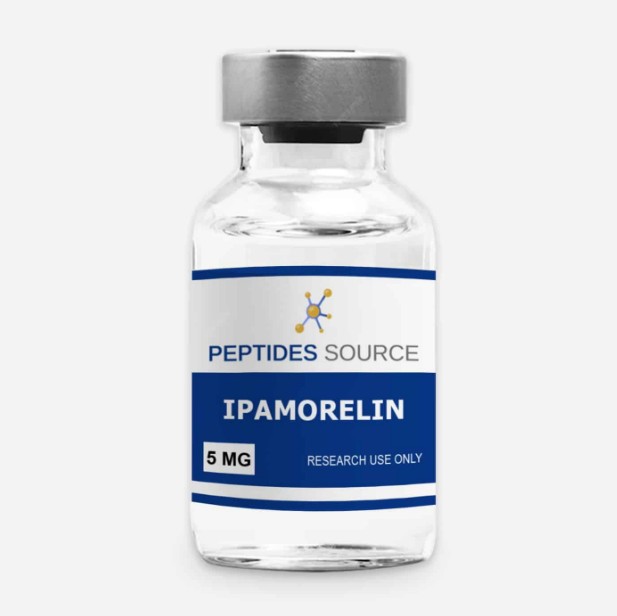
Peptides Source supplies Ipamorelin in multiple formats to support both individual and combination protocol research. Individual formats include Ipamorelin 5mg and Ipamorelin 10mg vials. Combination blend formats include the CJC-1295 No DAC 5mg/Ipamorelin 5mg (10mg blend), Tesamorelin 5mg/Ipamorelin 5mg (10mg blend), Tesamorelin 6mg/Ipamorelin 2mg (8mg blend), Tesamorelin 12mg/Ipamorelin 6mg (18mg blend), and Tesamorelin 13mg/Ipamorelin 3mg (16mg blend) – providing researchers with flexibility across both single-variable and dual-pathway experimental designs.
Current Evidence Base and Research Boundaries
The Preclinical Nature of the Ipamorelin Literature
With the exception of the limited gastrointestinal Phase 2 clinical program, the Ipamorelin research literature is almost entirely preclinical – conducted in rodent and swine models using standardized pharmacological, endocrinological, and bone biology experimental designs. The selectivity data established in the Raun et al. 1998 study has been consistently referenced and built upon in subsequent GH secretagogue research, but the translation of preclinical findings to clinical contexts has not been formally characterized through appropriately designed clinical trials for most research domains of interest.
Ipamorelin is not FDA-approved for any therapeutic indication. Researchers working with this compound should approach all preclinical findings as mechanistic data within the specific experimental systems used – not as established clinical knowledge.
Implications for Study Design
For laboratory investigators designing GH axis studies with Ipamorelin, key protocol considerations include the selectivity advantage relative to alternative GH secretagogues, the signal transduction mechanism and its distinction from GHRH receptor-mediated GH release, the time course of GH pulse elevation documented in preclinical models, and the experimental endpoints most relevant to the specific research question being investigated. Institutional review and appropriate oversight are essential prior to initiating any in-vivo research involving GH axis peptides.
Handling, Storage, and Quality Considerations
Storage and Reconstitution
Lyophilized Ipamorelin should be stored at −20°C for long-term preservation, protected from light and moisture. Repeated freeze-thaw cycles should be avoided through single-use aliquoting prior to initial reconstitution. Reconstitution follows standard laboratory handling, with reconstituted solutions stored at 4°C and used within supplier-specified timeframes.
Purity and Sourcing Standards
For research integrity in GH axis studies, Ipamorelin should be sourced from a supplier providing batch-specific Certificates of Analysis (COAs) with HPLC purity data and mass spectrometry identity confirmation. Given that Ipamorelin’s research value is specifically tied to its GHS-R1a selectivity profile, compound purity is directly relevant to experimental validity – impurities with off-target receptor activity could introduce the very hormonal confounds that Ipamorelin’s selectivity is designed to eliminate.
Research-grade Ipamorelin should meet a minimum purity threshold of 98%, with 99% or above preferred for mechanistic studies requiring high pharmacological precision.
Peptides Source supplies Ipamorelin in 5mg and 10mg vial formats, manufactured through WHO/GMP and ISO 9001:2008 approved manufacturers with 99% purity standards and third-party batch testing documentation. Multiple combination blend formats are available for dual-pathway research protocol design.
Ipamorelin in the GH Secretagogue Research Landscape
Ipamorelin’s position in the GH secretagogue research literature is defined by a single, pharmacologically precise property: GHS-R1a selectivity. This characteristic – first formally established in the Raun et al. 1998 study and consistently referenced in the three decades of GH axis research that followed – makes Ipamorelin the preferred research tool for investigators who require clean, ACTH- and cortisol-unconfounded GH axis stimulation in preclinical model systems.
Its utility extends across GH pulsatility research, bone biology investigation, gastrointestinal motility studies, and multi-compound combination protocols with GHRH analogs- providing a versatile research tool whose mechanistic specificity enables experimental designs of precision not achievable with earlier, less selective GH secretagogues.
For context on how Ipamorelin fits within the broader growth hormone axis research landscape, including its relationship to GHRH analogs and the pharmacological basis of combination protocols, refer to the Growth Hormone Axis Research category overview in the Peptides Source research blog. For information on its most extensively characterized GHRH analog combination partner, see the Tesamorelin Research Overview.
DISCLAIMER – FOR RESEARCH USE ONLY The content in this article is for educational and informational purposes only, based on published scientific literature. The compounds discussed are not FDA-approved for human or veterinary use and are strictly intended for in-vitro laboratory research by qualified professionals. Peptides Source does not endorse or support the use of these compounds outside of a controlled research environment. Nothing in this article constitutes medical advice.
References
- Raun K, Hansen BS, Johansen NL, et al. Ipamorelin, the First Selective Growth Hormone Secretagogue. European Journal of Endocrinology. 1998;139(5):552–561.
- Hansen BS, Raun K, Nielsen KK, et al. Pharmacological Characterisation of a New Oral GH Secretagogue, NN703. European Journal of Endocrinology. 1999;141(2):180–189.
- Svensson J, Lall S, Dickson SL, et al. The GH Secretagogues Ipamorelin and GH-Releasing Peptide-6 Increase Bone Mineral Content in Adult Female Rats. Journal of Endocrinology. 2000;165(3):569–577.
- Andersen NB, Malmlöf K, Johansen PB, et al. The Growth Hormone Secretagogue Ipamorelin Counteracts Glucocorticoid-Induced Decrease in Bone Formation of Adult Rats. Growth Hormone & IGF Research. 2001;11(5):266–272.